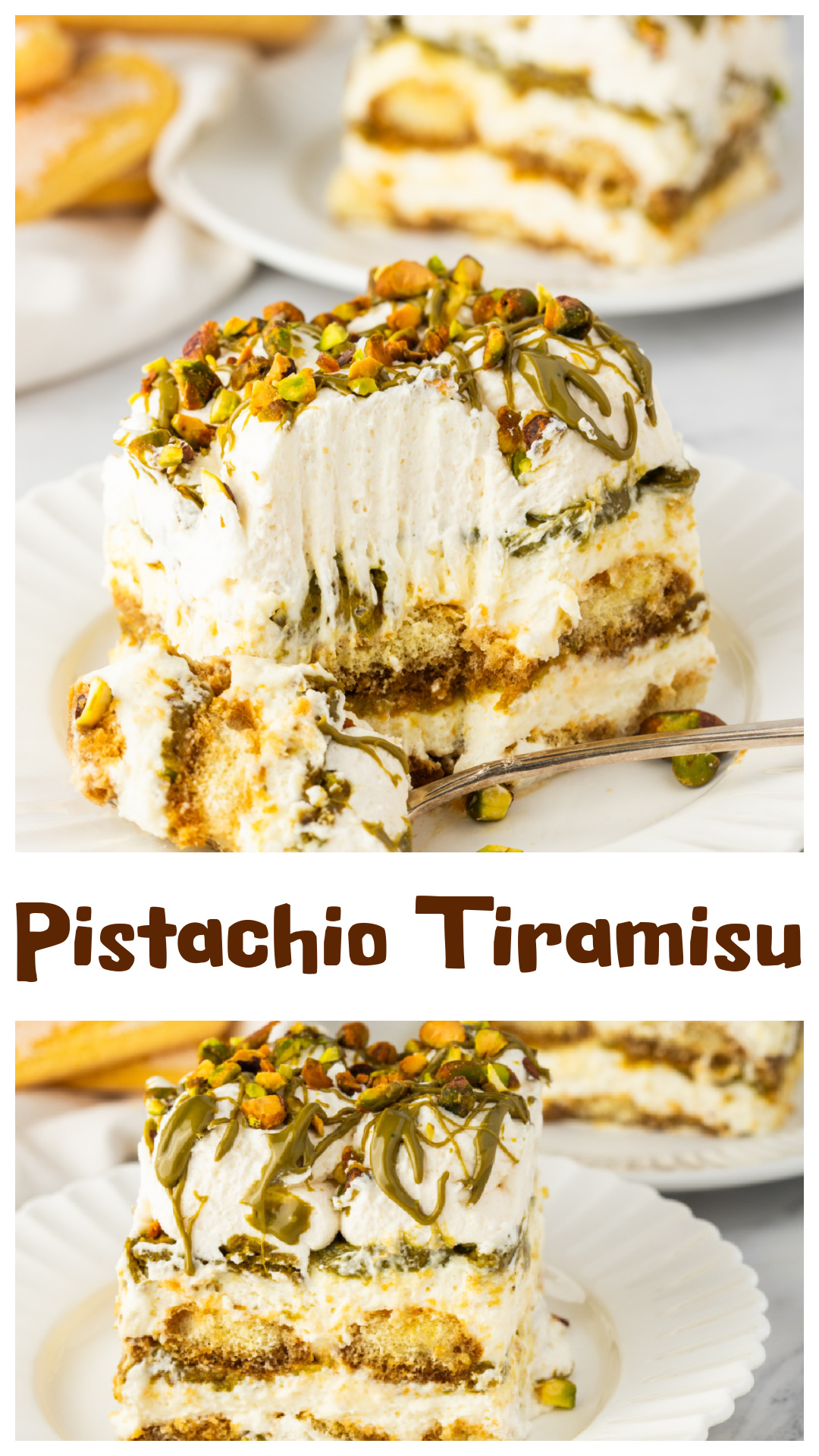
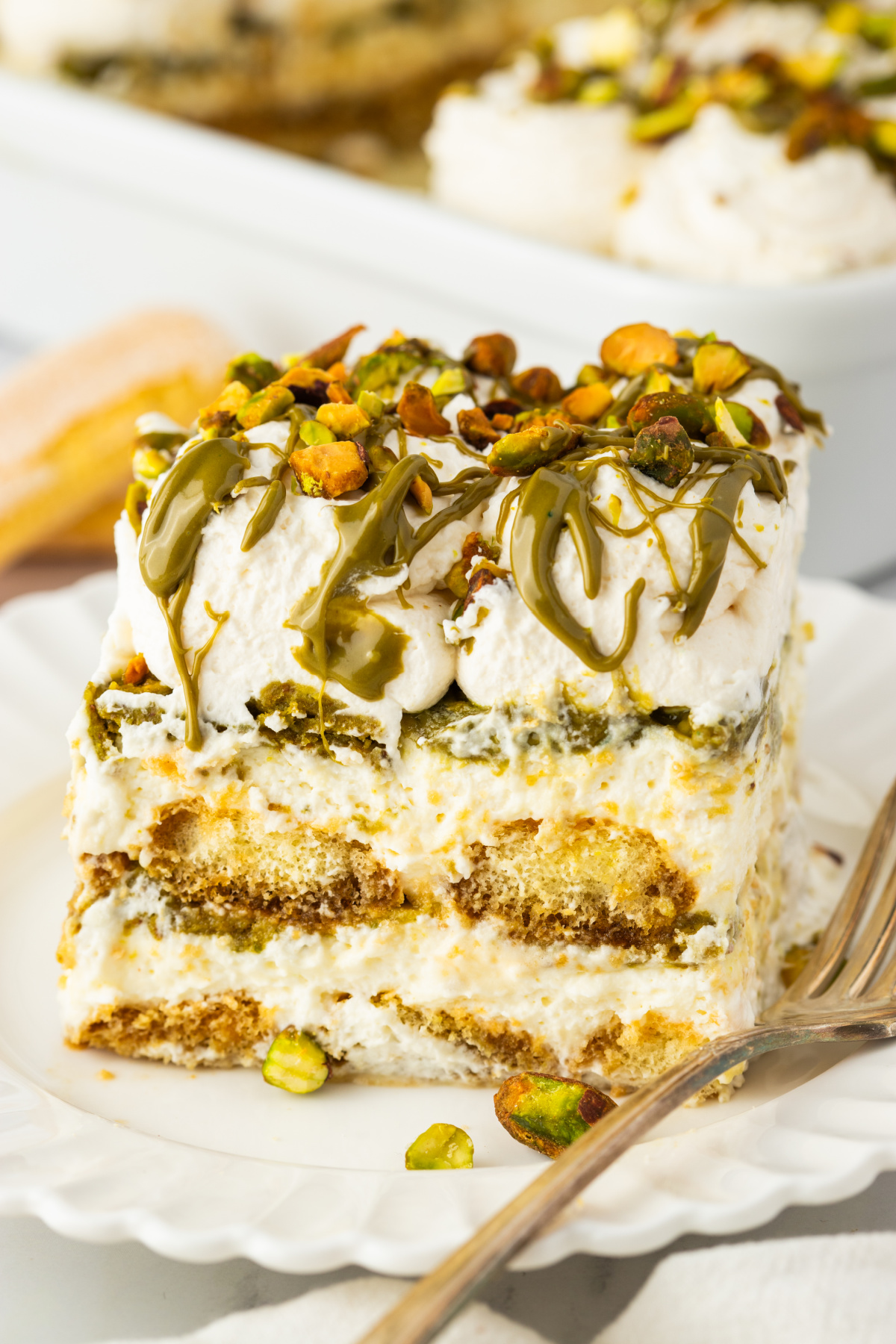
A pistachio tiramisu made without eggs or custard, layered with espresso-soaked ladyfingers, mascarpone cream, and homemade pistachio cream in every layer.
Pistachio Tiramisu, and the Time I Ate All the Pistachios
Pistachio tiramisu is what this turns into. It’s not where it starts.
It begins with pistachios, back when they weren’t just sitting in a bag at the store like they are now. They were expensive, imported and something that really only showed up in a tin around the holidays and were put out like it was special. You didn’t just eat them, instead, you took a few, put the lid back on, and left them alone.
At that time they were also dyed that bright, unnatural red, which I later found out was to cover up shells that weren’t perfect looking. It meant if you touched them, you couldn’t hide it. Your hands would tell on you immediately. They felt closer to something you weren’t supposed to touch than something you were meant to eat.
I was four. I found them anyway.
I took the whole tin into my room and sat on the floor and ate all of them. I didn’t just take a handful, or “some.” I ate every single one. I remember being so completely focused, cracking shells, eating, and not stopping until there was nothing left and my hands were stained red like I’d done something way bigger than I had.
I walked out into the front room where my mom was sitting with her friends, and she saw my hands first.
“What happened to your hands?”
“Were you eating pistachios?”
“Yes.”
“Where are they?”
“I ate them.”
And that was the moment it turned into something I wasn’t expecting.
Because she reacted like I had just eaten bricks of gold instead of just grabbing a snack. That I should have known better, and I had crossed a line I should have understood. And she did it right there, in front of everyone, like it was something that needed an audience.
Which, if you knew me then, was the worst possible version of it.
I was so shy, never misbehaved and didn’t want attention or eyes on me. I didn’t want to be the center of anything, and suddenly I was standing there with red hands while she went off in front of her friends.
And the part that didn’t make sense to me wasn’t even that she was mad. It was that she did it like that. Because we didn’t do that. I was raised to keep things private. You didn’t put things on display in front of people and I knew that rule very well at age four.
And she just did. So I left the room without really saying anything.
I went into the cabinet where all the photo albums were kept. My dad was an executive at Eastman Kodak, so pictures weren’t rare in our house. They were everywhere. Every photo also existed as a negative somewhere. In my mind, that meant nothing was permanent. If something got ruined, it could be made again. At least that’s what my dad always said.
That was my logic.
I took the most recent albums and a red Sharpie and went over by the fireplace in the formal living room, I can still vividly see myself doing this. I laid down on the floor and started at the beginning.
Page by page.
I pulled back the plastic and marked over her face in every single picture. Carefully. Completely. I wasn’t doing it fast or in a sloppy way. I was very careful about it. Birthdays, holidays, baby pictures, whatever had been printed and saved over the last several years, I went through all of it.
And while I was doing that, she was still in the other room with her friends.
Then they left. And she came looking for me. And she found me like that, on the floor, red marker in my hand, in the middle of it. And that’s when it really escalated.
Because now it wasn’t just the pistachios, it was everything. And I remember exactly what I said, because it made perfect sense to me. “What’s the big deal? Daddy works for the picture company. He can make as many new ones as you want.”
It was pure defiance, but also completely logical in my head.
Because I hadn’t destroyed anything. I had just changed it. And if it mattered that much, it could be fixed. He had the negatives. That’s where the real pictures were, because he told me that.
That made it worse.
And those albums didn’t go away. They went right back into the cabinet. And every once in a while, someone would pull one out looking for something, flip a page, and there it was again. Red, right across her face and it never got fixed. The pictures were never reprinted. It just stayed there.
All of that over a tin of pistachios. Something that, at the time, you weren’t supposed to take and enjoy however you wanted.
I don’t treat them like that anymore. I use them however I want.
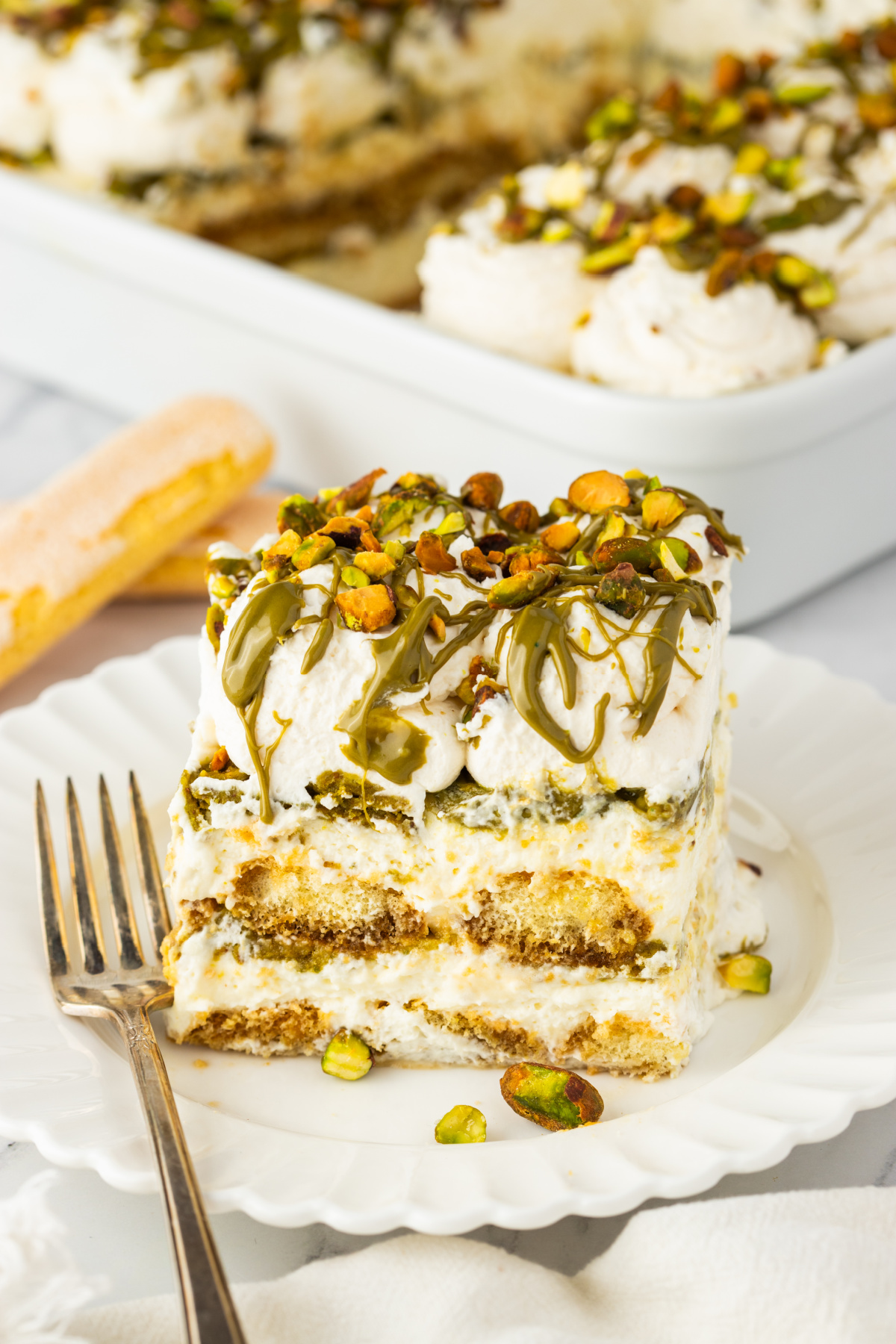
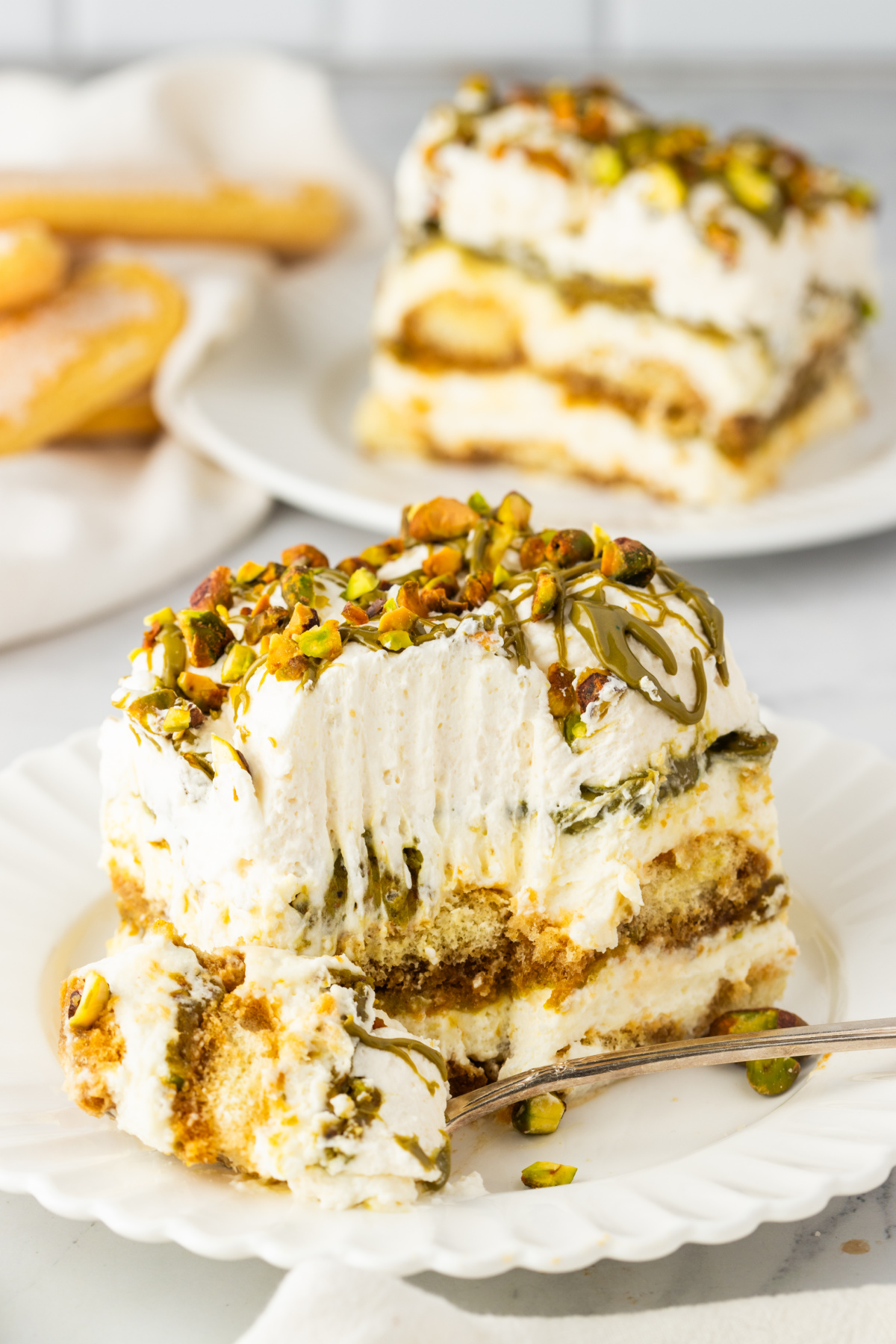
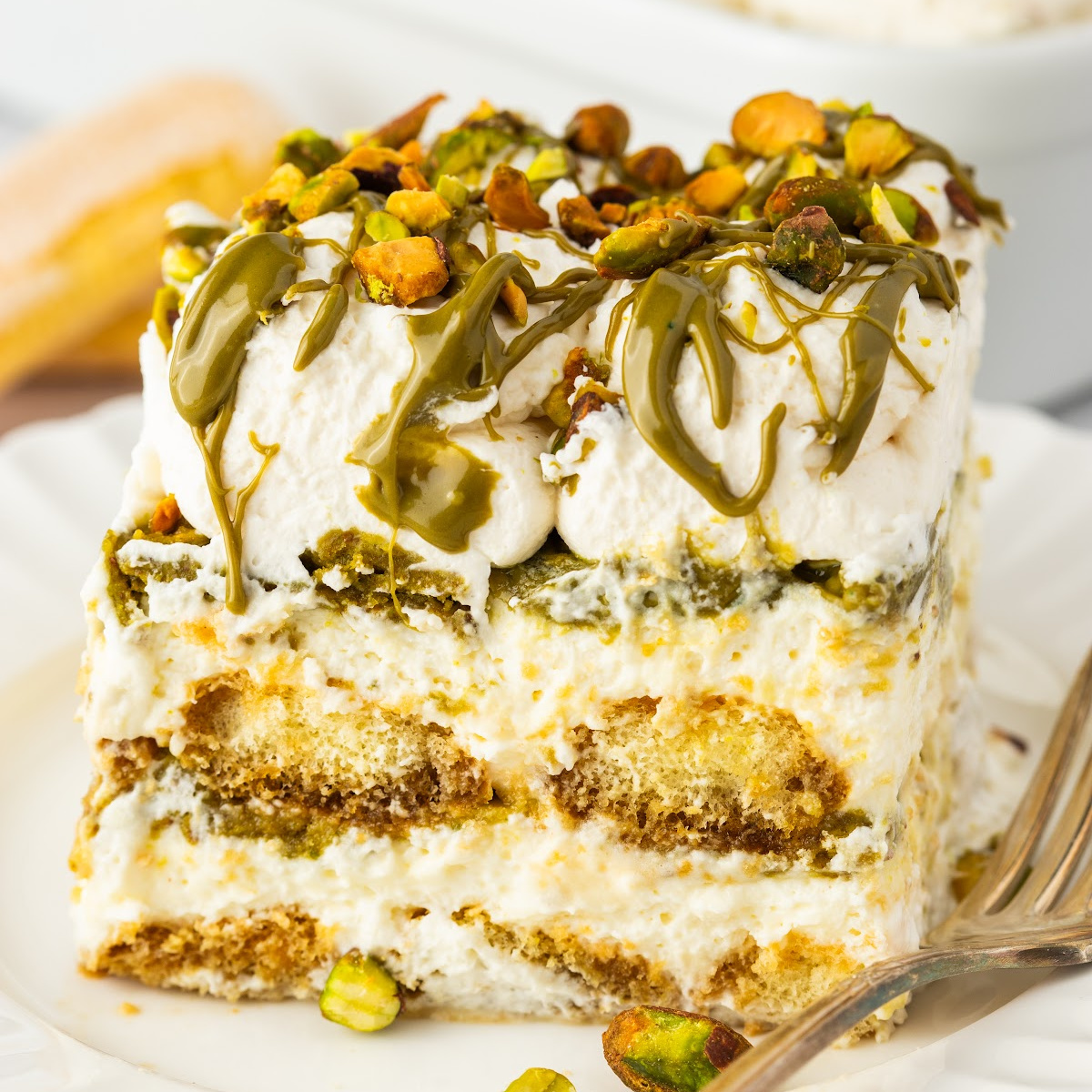
My pistachio tiramisu has everything you expect, espresso-soaked ladyfingers, a mascarpone filling that sets up in the fridge, sliceable layers, but I took the flavor all the way in one direction.
There’s a homemade pistachio cream worked into it, layered throughout so it ends up in every bite instead of sitting off to the side. I made it with real pistachios, white chocolate and oil so it blends smoothly and spreads easily, not thick or gritty.
The filling skips the whole egg and custard process and uses mascarpone with whipped cream instead, so it’s lighter, easier to handle, and still holds together once it’s chilled long enough.
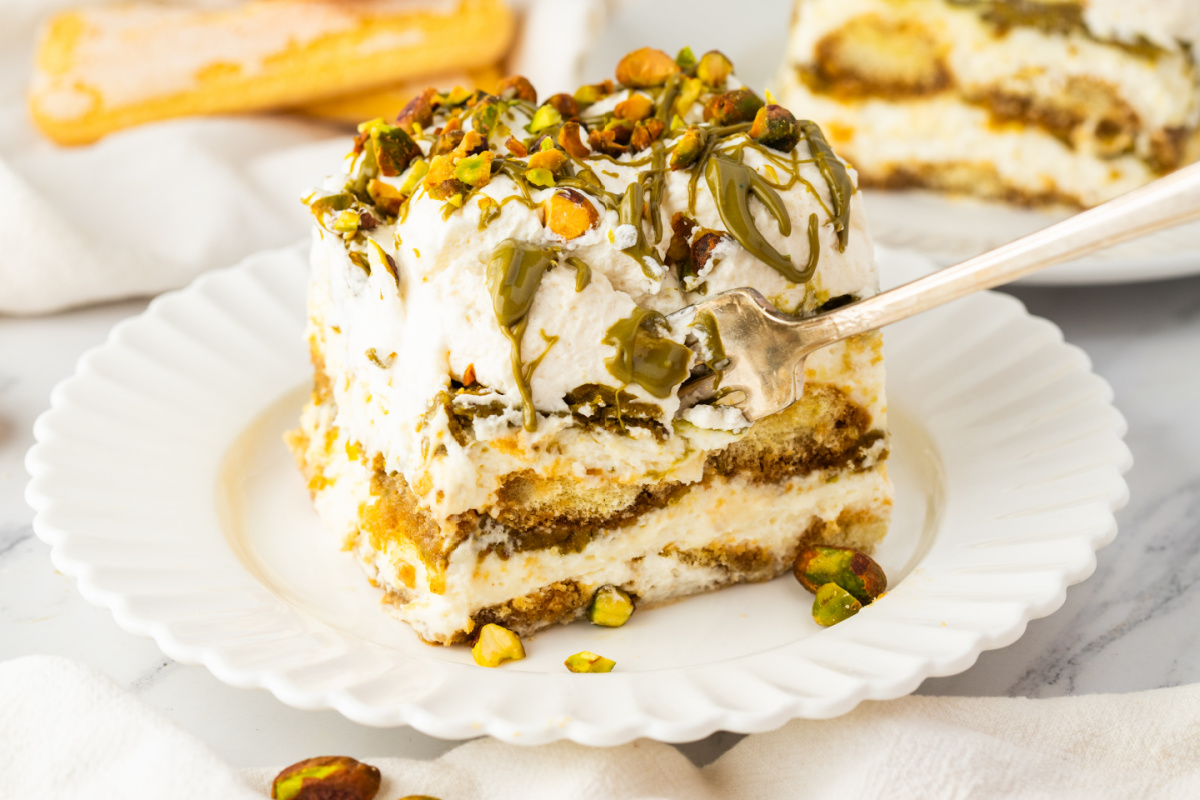
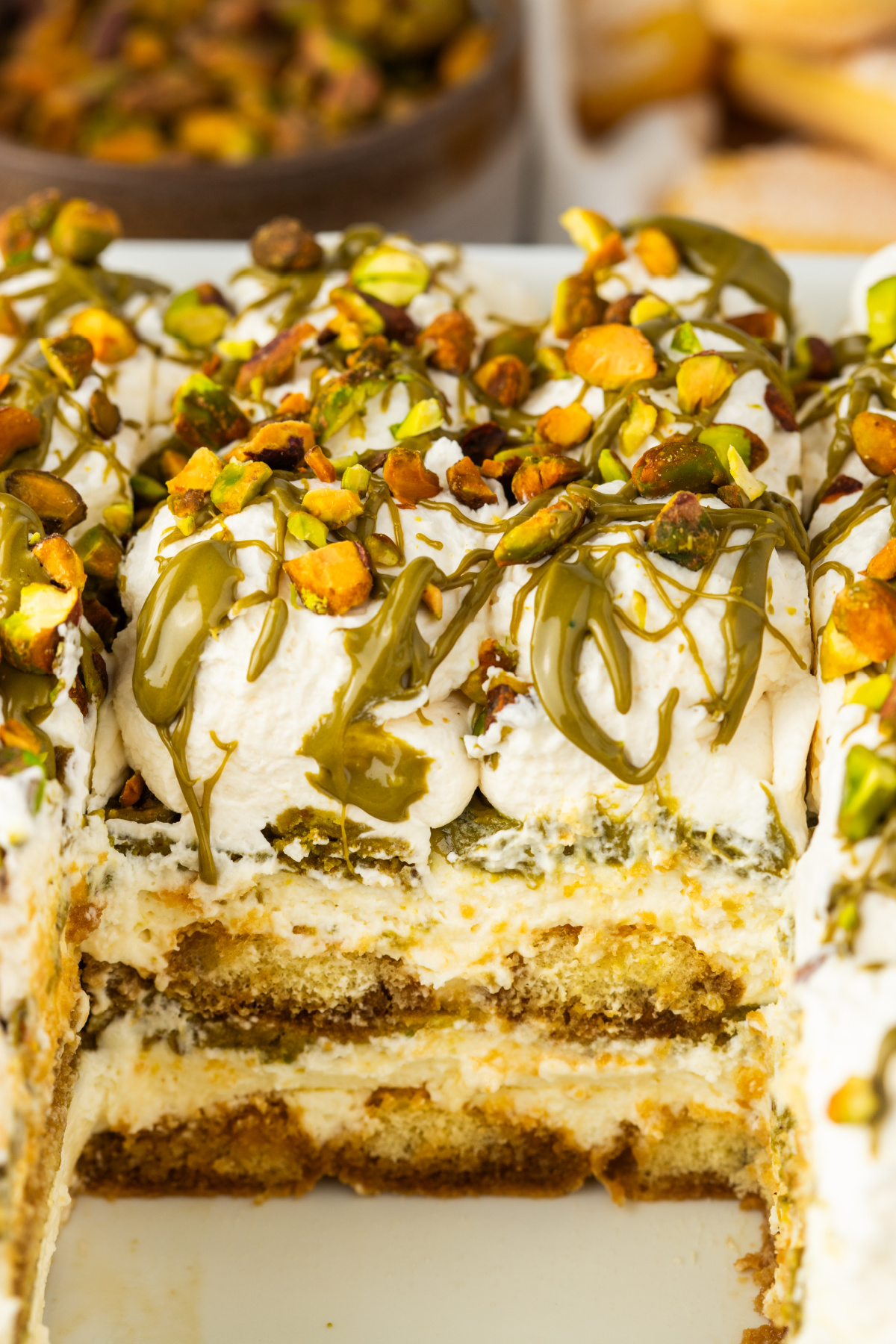
After a night in the fridge it slices into neat, distinctive layers instead of just a scoop of something.
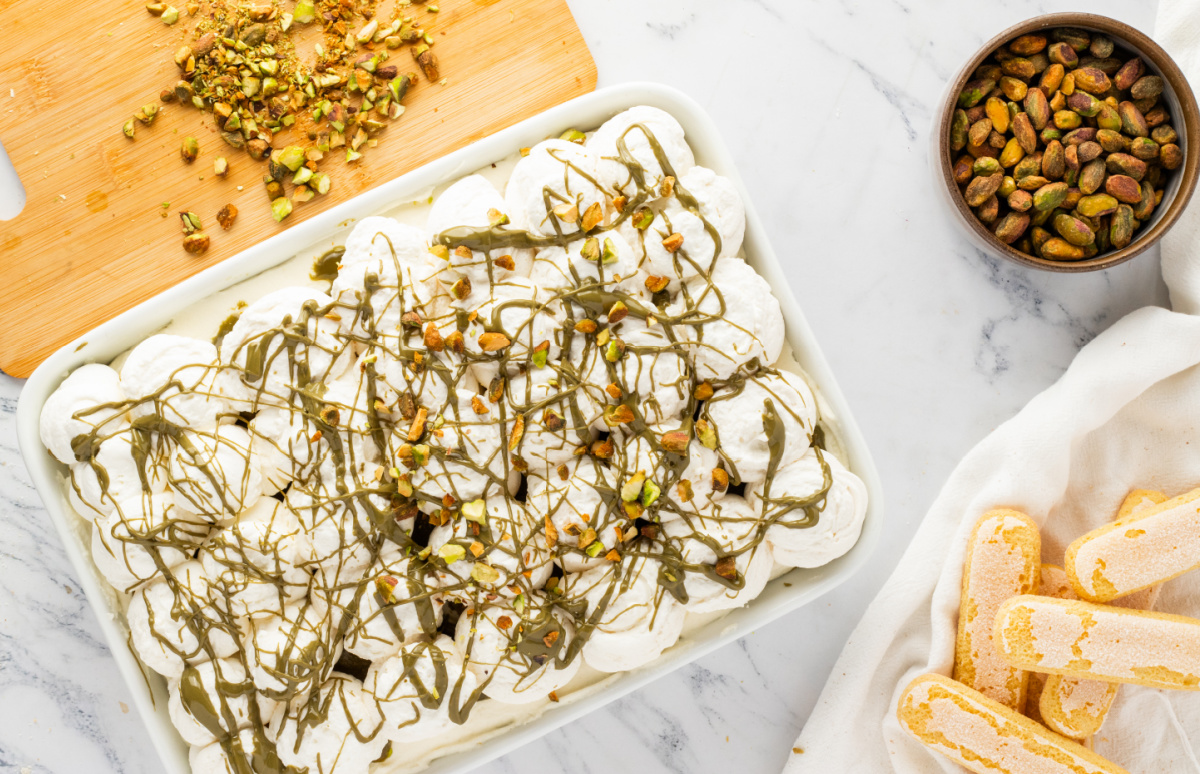
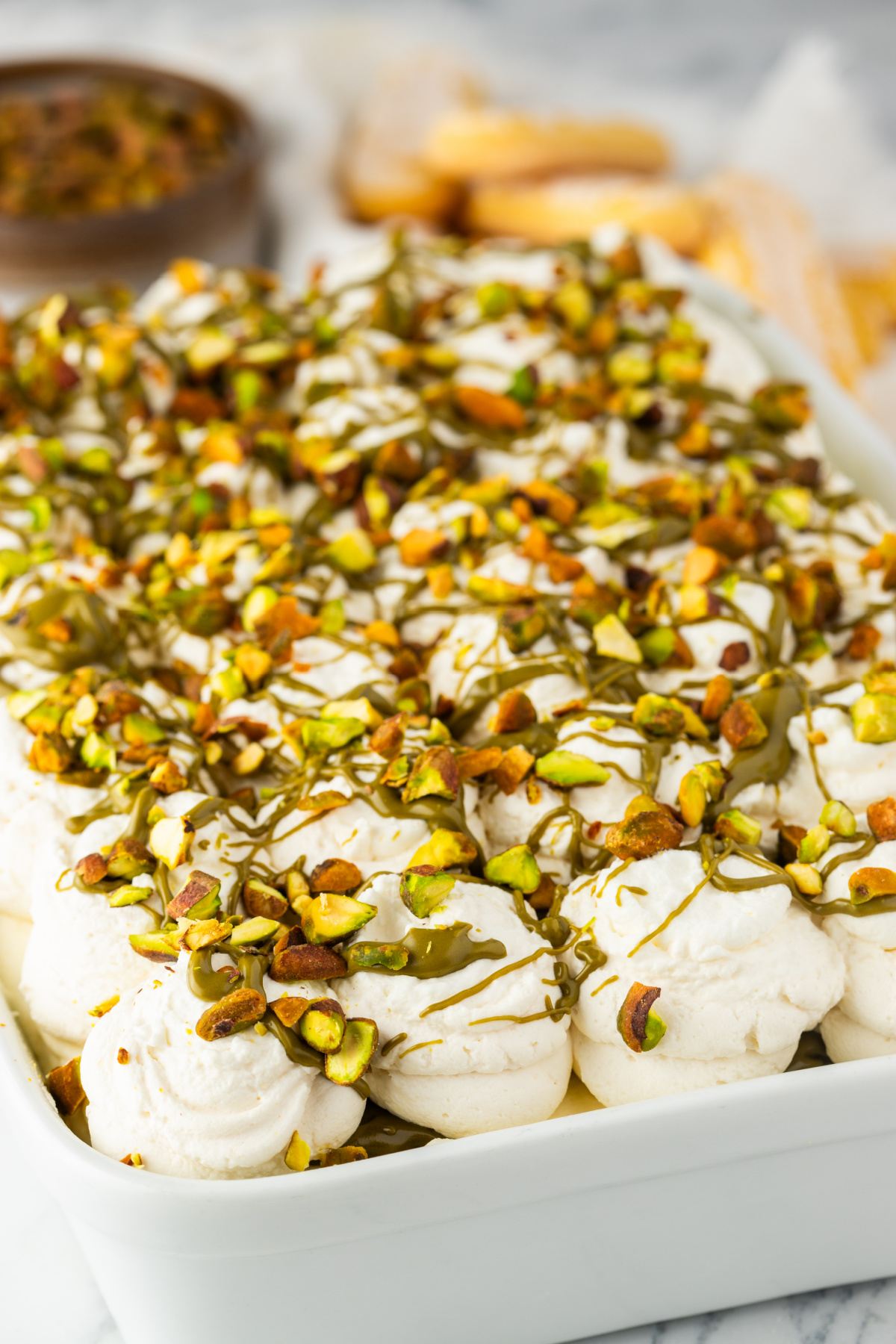
And at the end, it looks finished. I piped clouds of whipped cream on top, added a little more pistachio for texture and drizzled more pistachio cream. It looks like something you meant to make, if that’s important to you.
Which is a very different way of treating pistachios than eating an entire tin on the floor and trying to explain it later.
What Makes This Tiramisu Different
- You don’t need a lot of pistachio, but it needs to show up more than once. They’re not mixed into the mascarpone and left at that. I layered them in, lightly, between each level so they show up the whole way through instead of sitting on top like an afterthought.
- The pistachio cream is what changes the whole dessert. It’s made from real pistachios with a little white chocolate and oil so it blends smoothly and spreads without tearing up the layers. It’s not thick or gritty, and it’s not overly sweet.
- I skipped the egg and custard part completely. The filling is mascarpone folded with whipped cream, so it stays light and holds together without needing anything else. It’s easier to work with and doesn’t rely on timing things perfectly. I know many of you prefer that.
- Everything else stays the same. The ladyfingers get dipped quickly so they don’t fall apart, the layers go in evenly, and then it sits long enough to come together. That part matters more than anything you add.
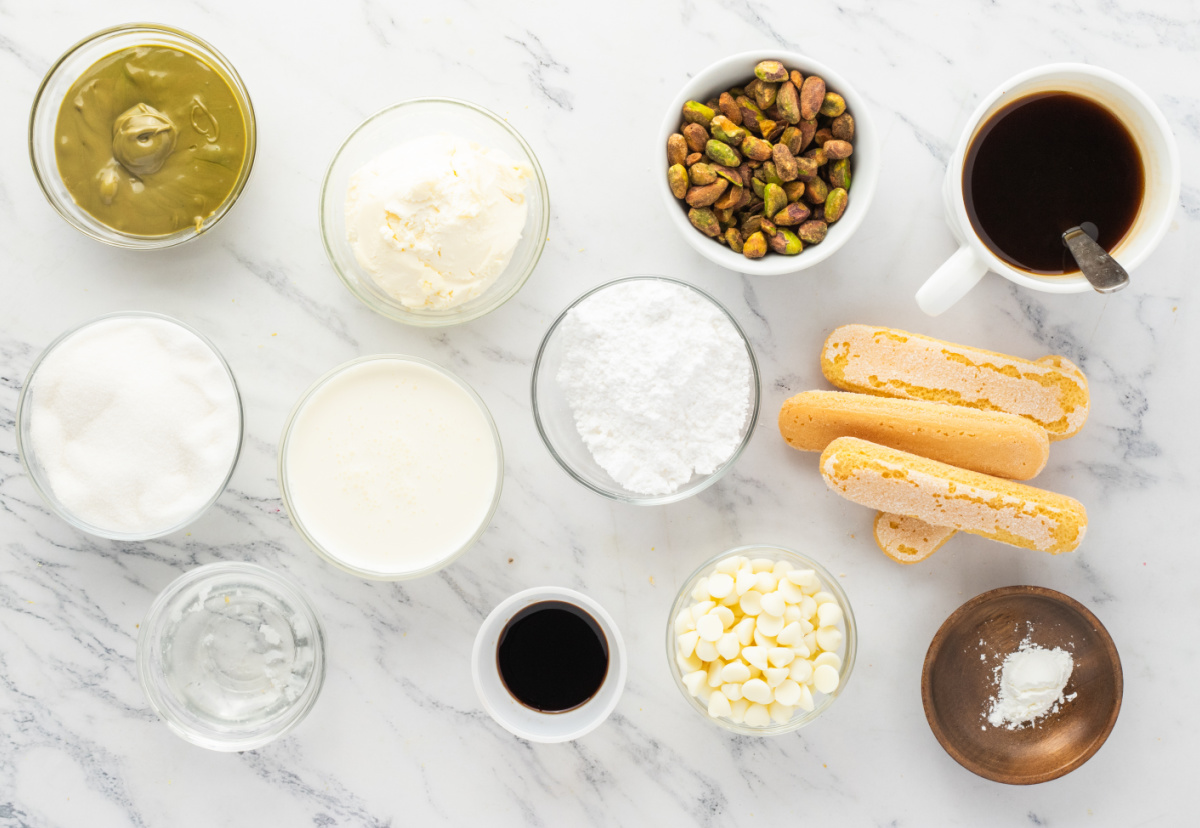
Ingredients
- Pistachios – Shelled and unsalted. These get blended into the cream, so skip anything salted.
- White chocolate – This is what smooths the pistachio cream out and gives it body. Without it, you’re closer to a paste than something spreadable. White chocolate bars melt smoother than chips.
- Neutral oil – Just enough to loosen the pistachio mixture so it blends properly.
- Confectioners’ sugar – Optional in the pistachio cream if you want more sweetness. Also used in the filling and topping.
- Coffee or espresso – Strong and cooled. It needs to hold its own against the pistachio without going bitter.
- Granulated sugar – Takes the edge off the coffee so it blends in the finished layers.
- Mascarpone – Cold and full-fat. This is the base of the filling, and it holds everything together once it sets.
- Heavy whipping cream – Whipped to stiff peaks and folded in. This is what keeps the filling and topping light but still able to hold up.
- Ladyfingers – The crisp kind, not soft cake-style. They need to soak and still keep their shape.
- Vanilla extract – Used in the filling and topping.
- Cornstarch – A small amount to stabilize the whipped cream so it holds longer.
How to Make Pistachio Tiramisu
Find the complete printable recipe with measurements in the recipe card at the BOTTOM OF THE POST.
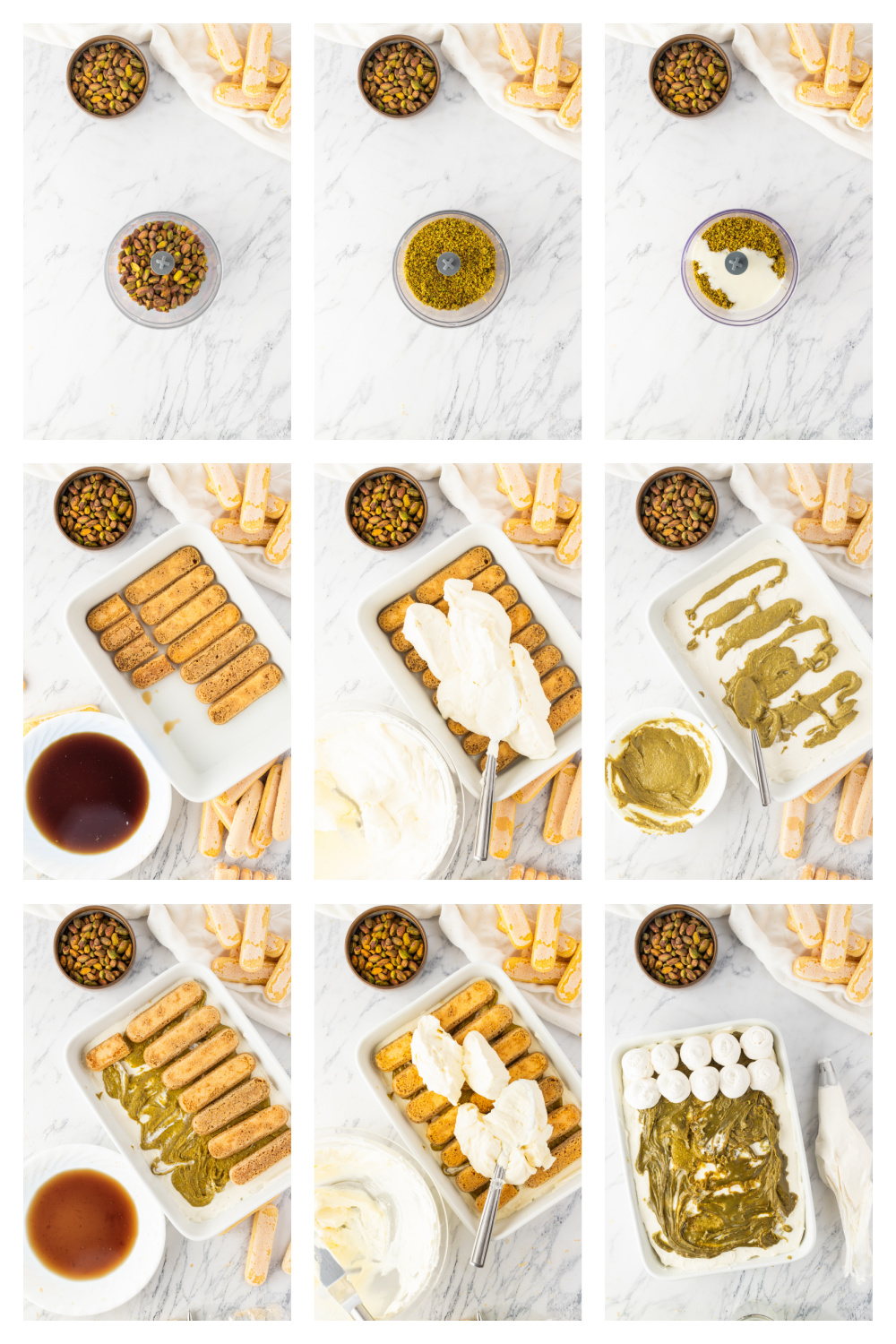
- Step One (make the pistachio cream)
Add the pistachios to a food processor and run them until they’re as smooth as you can get them, stopping to scrape things down when they start climbing the sides. Pour in the melted white chocolate and the oil, then keep going until it turns into something creamy and spreadable instead of thick and stubborn. Taste it. If it tastes more savory than you want, add a little confectioners’ sugar. Set it aside. - Step Two (coffee soak)
Stir the sugar and vanilla into the cooled coffee until it dissolves. It should taste like strong coffee that’s been slightly taken care of, not something sweet. Keep it close. You’ll move quickly once you start layering. - Step Three (mascarpone filling)
Mix the cold mascarpone with the confectioners’ sugar and vanilla until smooth. In another bowl, whip the cream to stiff peaks, then fold it into the mascarpone. Take your time here. If you get too aggressive with it, it loosens and you lose that thicker texture once it sets. - Step Four (start layering)
Working in a 9×13 dish, dip each ladyfinger quickly into the coffee and lay them down in a single layer. Don’t let them sit in the coffee. They’ll fall apart and you’ll feel it later. Spread half of the mascarpone over the top, all the way to the edges, then add a thin layer of pistachio cream, enough so it ends up in every bite. - Step Five (finish the layers)
Add another layer of dipped ladyfingers, fitting them in so there are no gaps. Spread the rest of the mascarpone over the top, then go back in with another thin layer of pistachio cream. Smooth it lightly or leave a little movement in it. Either way works. - Step Six (chill)
Cover it and put it in the fridge for at least 6 hours. Overnight is better. This is where it turns into what it’s supposed to be. If you cut it too early, you’ll know. - Step Seven (top and serve)
Whip the cream with the confectioners’ sugar, vanilla, and cornstarch until it holds stiff peaks. Spread it or pipe it over the top, drizzle with a little more pistachio cream, and finish with chopped pistachios. It should look finished when you’re done, not like you stopped halfway.
Recipe Tips
- Don’t let the ladyfingers sit in the coffee. A quick dip is all they need. Leave them in too long and they fall apart, and then you’re working around that mess.
- Keep the pistachio cream thin in the layers. It’s not there to take over the whole dish. Too much at once and it throws everything off.
- The mascarpone needs to be cold when you start. If it’s soft or warm, it won’t hold the same way once everything is combined.
- Fold the whipped cream in gently so it doesn’t deflate. If you hurry it or overmix, the filling loses that thicker texture and won’t hold when you slice it later.
- If the pistachio cream feels stiff, loosen it slightly before you start layering. It should spread without dragging everything underneath it out of place.
- Give it enough time in the fridge. This isn’t optional. It needs those hours to come together and hold. Cutting into it early just shows you didn’t wait.
- When you’re layering, go all the way to the edges. Gaps show up once it’s sliced, and there’s no fixing it after.
- The topping should stay in place. If it looks soft or runny, keep whipping. It needs to sit on top, not melt into the layers underneath.
Storage
- Keep it in the fridge, covered. Once it’s set, it keeps for a couple of days.
- If you made it ahead, leave the topping off until closer to serving if you want it to look the way you expect. It tastes the same either way, but the finish holds better when it’s fresh.
- After the first day, the layers soften a little more. It’s not a bad thing, just a little different.
- If you’re storing leftovers, keep them covered so the top doesn’t dry out or pick up anything from the fridge. It’s not delicate, but it does better when left alone.
- You can freeze it, but it changes the texture once it comes back. It works, just not as smooth. If you go that route, wrap it well and thaw it in the fridge so it doesn’t get watery.
- This isn’t something to leave out. Take what you need, put it back, and let it stay cold.
FAQs
- Can I use store-bought pistachio cream?
Yes. Keep the layers lighter since most jarred versions are sweeter and thicker than this one. If it feels stiff, loosen it slightly with cream. - Can I make pistachio tiramisu without eggs?
That’s exactly what this is. There is no custard or raw eggs. The mascarpone and whipped cream do the job and hold once it’s had time to sit. - How long does it need to chill?
At least 6 hours, but overnight is better. That’s when it becomes sliceable. - What kind of coffee should I use?
Anything strong that isn’t bitter. Espresso is great, but a bold brewed coffee is fine. Let it cool before you start. - Why did mine turn out too soft?
Usually one of two things: the ladyfingers sat in the coffee too long, or it didn’t chill long enough. Both are easy to fix next time. - Can I skip the pistachio cream?
You can, but that’s where most of the flavor comes from. Without it, you’re closer to a standard tiramisu with pistachios on top. At that point, serve it with my pistachio ice cream.
From My Kitchen Notes
Just a few observations.
- It wasn’t even about the pistachios. It was about how quickly something small turns into something you’re not allowed to come back from.
- If something can be replaced, it doesn’t always mean it didn’t matter. Sometimes it means you misunderstood what mattered.
- You can watch something happen in front of you and still decide not to touch it.
- Some people react immediately. Some people wait until they can see clearly, and then they don’t miss.
- It’s interesting what gets called “too much.” What doesn’t.
- You learn pretty quickly whether mistakes are temporary or if they follow you around.
- If something can be reprinted, I didn’t think I was destroying anything. I thought I was testing how permanent things really were.
- You can leave something exactly where it is and still know it’s not staying that way.
- There’s always a moment where you either do something about it or you let it become something else.
- If you’re going to be remembered for something, it’s rarely the part you thought mattered.
- Letting something sit doesn’t keep it neutral. It just delays what it turns into.
- There’s a difference between being corrected and being made into a story.
- I never misbehaved as a child, so the red Sharpie incident was surprising even to me. For me it was a response to how I was taught to handle things. Privately and quietly. Not in front of everyone.
- I wasn’t trying to win. I was trying to correct something.
- There’s always a moment where someone could step in. Not everyone does.
- The red dye on my hands and the red marker in the albums wasn’t a coincidence.
- At some point it’s not about whether you saw it. It’s whether you did anything with it.
- Some reactions are about the moment. Some are about making sure it doesn’t happen again.
- There are things that don’t get fixed right away on purpose.
- Waiting can mean patience, or it can mean nothing’s going to happen. You can usually tell which one it is.
- I now buy pistachios in bulk. And eat as many as I want.
- Not everything breaks all at once. Sometimes it just stays where it is. It’s rarely the first thing that does it. It’s what comes after.
More Tiramisu, No Detours
- Lemon Tiramisu – Lemon curd, mascarpone, bright layers.
- Tiramisu Brownies – Fudgy base, espresso soak, mascarpone topping.
- Toffee Tiramisu – Toffee bits, caramel notes, soft layers.
- Gingerbread Tiramisu – Molasses, spice, mascarpone layers.
- Tiramisu Cookies – Espresso, mascarpone, cocoa in cookie form.
- Pumpkin Tiramisu – Pumpkin puree, spice, mascarpone layers.
- Baileys Irish Cream Tiramisu – Baileys, mascarpone, cocoa finish.
- Raspberry Tiramisu – Raspberry syrup, mascarpone, layered.
This post may contain affiliate links. Please read my disclosure policy.
Pistachio Tiramisu
Equipment
- baking dish 9x13 (23x33 cm). Allows for even layering and neat slices.
- food processor Needed to fully smooth the pistachio cream.
- hand mixer or stand mixer. For whipping cream to peaks.
- 2 mixing bowls Large and medium.
- rubber spatula For folding without deflating.
Ingredients
Pistachio Cream:
- 1½ cups (180 g) unsalted, shelled pistachios
- 3 oz (85 g) white chocolate finely chopped, melted (use a bar, or chips)
- 1½ tbsps (22 ml) neutral oil
- 1½-3 tbsps (12-24 g) confectioners' sugar (optional)
Coffee Soak:
- 2¼ cups (540 ml) strongly brewed coffee or espresso cooled
- 3-4 tbsps (38-50 g) granulated sugar
- 1½ tsps (7 ml) vanilla extract
Mascarpone Filling:
- 24 oz (680 g) mascarpone cheese cold
- 1⅛ cups (140 g) confectioners' sugar
- 1½ tsps (7 ml) vanilla extract
- 3 cups (720 ml) heavy whipping cream
Assembly:
- 1½ packages (~300-350 g) ladyfingers cookies
- 1⅛ to 1½ cups (270-360 g) pistachio cream
Topping:
- 3 cups (720 ml) heavy whipping cream
- 6 tbsps (45 g) confectioners' sugar
- 1½ tsps (7 ml) vanilla extract
- 1½ tsps (4 g) cornstarch
- 6 tbsps (45 g) unsalted, shelled pistachios finely chopped
- extra pistachio cream for drizzling (optional)
Instructions
- Prepare the pistachio cream by blending the pistachios in a food processor until very smooth, stopping to scrape down the sides as needed. Add the melted white chocolate and neutral oil, then continue blending until the mixture becomes creamy and spreadable. Taste and add confectioners' sugar if you want it sweeter. Set aside.1½ cups (180 g) unsalted, shelled pistachios, 3 oz (85 g) white chocolate, 1½ tbsps (22 ml) neutral oil, 1½-3 tbsps (12-24 g) confectioners' sugar
- In a shallow bowl, combine the cooled coffee, sugar, and vanilla extract, stirring until the sugar is dissolved. Set aside.2¼ cups (540 ml) strongly brewed coffee or espresso, 3-4 tbsps (38-50 g) granulated sugar, 1½ tsps (7 ml) vanilla extract
- In a large bowl, mix the cold mascarpone, confectioners' sugar, and vanilla extract until smooth and fully combined. In a separate bowl, whip the heavy cream to stiff peaks. Gently fold the whipped cream into the mascarpone mixture until light and uniform, being careful not to deflate the mixture.24 oz (680 g) mascarpone cheese, 1⅛ cups (140 g) confectioners' sugar, 1½ tsps (7 ml) vanilla extract, 3 cups (720 ml) heavy whipping cream
- Working in a 9x13-inch (23x33 cm) dish, quickly dip each ladyfinger into the coffee mixture and arrange in a single layer, covering the bottom of the dish. Spread half of the mascarpone filling evenly over the ladyfingers, reaching all the way to the edges. Spoon a thin, even layer of pistachio cream over the mascarpone.1½ packages (~300-350 g) ladyfingers cookies, 1⅛ to 1½ cups (270-360 g) pistachio cream
- Add a second layer of dipped ladyfingers, arranging them tightly to fully cover the surface. Spread the remaining mascarpone filling evenly over the top. Finish with another thin layer of pistachio cream, smoothing gently or lightly swirling for a marbled effect.
- Cover the dish and refrigerate for at least 6 hours or overnight to allow the layers to set and the flavors to develop.
- For the topping, whip the heavy cream, confectioners' sugar, vanilla extract, and cornstarch to stiff peaks. Use a piping bag with a large round tip and hold it straight up and down to pipe the whipped cream in soft, rounded mounds across the top, working in rows so the surface is fully covered without flattening it. You can also just spread the whipped cream over the top if you don't want to pipe it. Drizzle lightly with additional pistachio cream and finish with finely chopped pistachios before serving.3 cups (720 ml) heavy whipping cream, 6 tbsps (45 g) confectioners' sugar, 1½ tsps (7 ml) vanilla extract, 1½ tsps (4 g) cornstarch, 6 tbsps (45 g) unsalted, shelled pistachios, extra pistachio cream
Notes
- Keep the mascarpone cold to prevent the filling from loosening.
- Melt the white chocolate in short bursts in the microwave, stirring in between so it doesn’t seize. If using white chocolate chips, melt gently and blend a little longer to smooth it out.
- Ladyfingers should be dipped quickly to avoid oversaturation. Don’t stress exact count used, just do full layers edge to edge.
- Pistachio cream should be spread in thin, even layers for the best flavor distribution. Start on the lower volume end and add more if you want stronger pistachio presence.
- You can use store-bought pistachio cream, but you will need to thin it out to be able to drizzle it.
- Overnight chilling gives the best slices, texture and flavor.
- Add the whipped topping just before serving for the best finish.
Nutrition
Have you made this Pistachio Tiramisu? I’d love to hear how it turned out — leave a comment below and let me know.
As an Amazon Associate and member of other affiliate programs, I earn from qualifying purchases.
Ron JJ says
I have to say this story is brutally perfect. The actual precision you retaliated with at four is stellar. Sharpie execution? Unmatched. And you delivered it quietly, like you were supposed to. You were essentially unf*ckwithable at age four and that is very cool.
Karen says
Made this for a small get together and it was gone by the end of the night. People kept asking what was in the green layer. The pistachio comes through without being overpowering. I’ll double it next time.
Misha says
Followed the instructions exactly and the only thing I’ll say is don’t rush the chill time. I tried a corner early and it wasn’t the same. Next day it cut clean and held together. Worth the wait.
Benson says
I almost skipped making the pistachio cream from scratch and I’m glad I didn’t. It spreads so much easier than the jar I had in the pantry and didn’t feel overly sweet. The layers stayed separate and you can taste it all the way through. We really liked it. Fun recipe and very unique.
ara says
I’ve made tiramisu a few times and this is the first one that didn’t turn into a soft mess when I cut it. The pistachio layer is what makes it. I used a bar for the white chocolate like you said and it blended way smoother than I expected. Let it sit overnight and it came out exactly how you described.
Kathy F says
This was AMAZING! What a fun take on tiramisu this was. Everyone loved it at the party I took it too.