
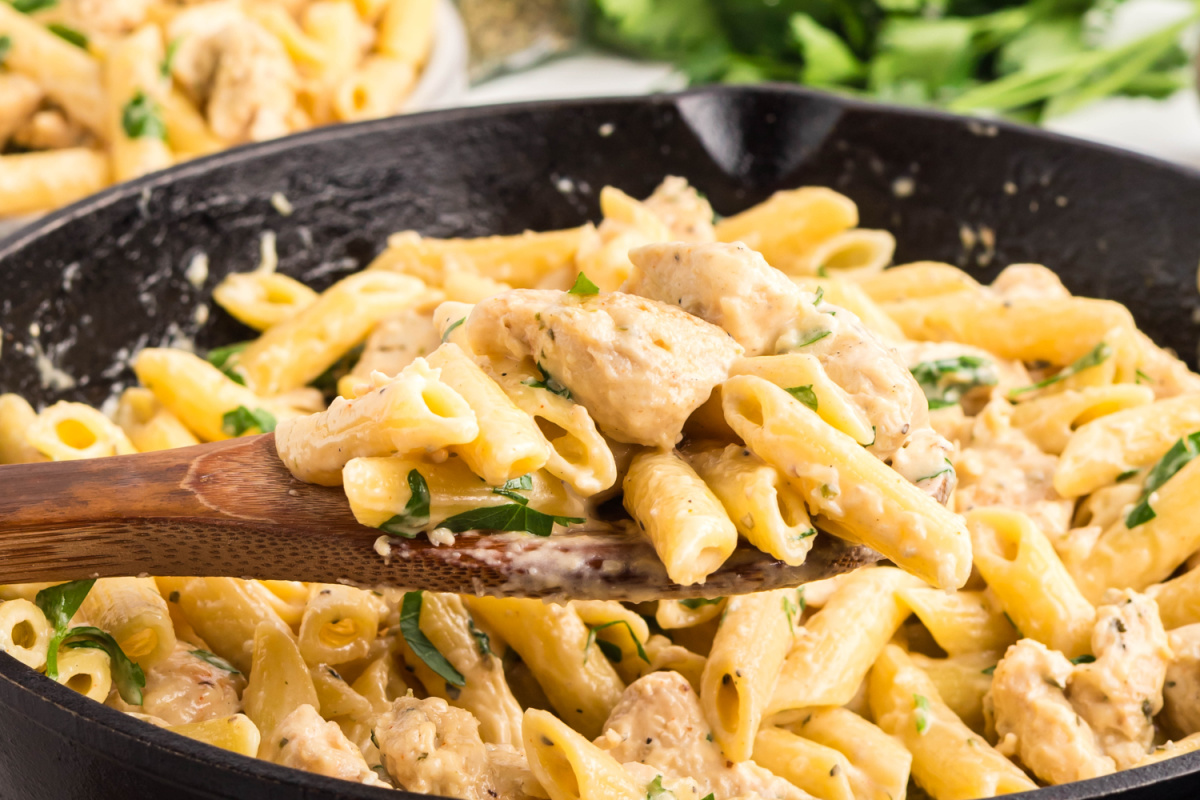
Creamy garlic chicken pasta is the recipe I made for the white sauce kids when my house was full of teenagers who had lots of opinions about pasta. Tender chicken and penne are tossed in a garlicky Parmesan cream sauce with lots of garlic and freshly grated Parmesan.

Creamy Garlic Chicken Pasta with Parmesan Cream Sauce
I made some form of this creamy garlic chicken pasta for years while feeding a house full of teens. I needed it to be easy enough to make in larger amounts and forgiving enough when I was distracted. But most importantly, it had to be something the white sauce kids would eat.
Because there were red sauce kids and white sauce kids.
This was back when my boys were still at home and our house had become the house everyone came to. There were always extra kids downstairs, lots of cars in the driveway and no guarantee that the number of people I thought I was feeding at four o’clock had anything to do with the number standing in my kitchen by dinner. They all had opinions, which I was totally fine with.
Not every kid liked tomato sauce. And some wanted nothing to do with anything creamy. Sometimes I’d get lucky and have a house full of one camp. But lots of nights I made both. My own kids liked both, so they were never the deciding factor.
The red sauce group was easy. I could make a big pot of meat sauce and boil enough pasta to feed whoever had found their way here that afternoon. But I refused to make the white sauce kids plain buttered noodles and Parm while everyone else was getting something with a little more substance. So I added chicken.
That was the beginning of this creamy garlic chicken pasta, although I wasn’t calling it that at the time. It was just the white pasta.
I made some variety of it for years, changing little things as I went. Sometimes it was more garlic or better seasoning on the chicken, with chicken broth in the pan before the cream, and enough Parmesan to give the sauce flavor without turning it into a paste.
By the time everyone grew up, I’d probably been messing with it for close to ten years. My recipe-development process was feeding teens until I noticed everyone’s plates were consistently cleaned. That’s when I stopped changing it.
And frankly, I’ve used worse systems.

The Decisions Behind This Recipe
- The chicken gets seasoned with Italian seasoning, paprika, garlic powder, salt and pepper right in the skillet. This is important in a creamy chicken pasta because the sauce shouldn’t have to carry all the flavor on its own.
- I use garlic twice, with garlic powder on the chicken and six cloves of fresh garlic cooked in butter for the sauce. They do different things, and the fresh garlic gets a minute in the pan to soften before the chicken broth goes in and loosens everything left from browning the chicken.
- The sauce uses chicken broth, heavy cream and Parm instead of relying on a pan full of cream. The broth loosens everything left from browning the chicken and gives the sauce enough liquid to coat the penne without turning the garlic Parmesan sauce into glue.
- Penne always made the most sense when I was making this creamy garlic chicken pasta for a house full of kids because I could cook a lot of it and nobody had to mess with long noodles. I never had a reason to change it because the ridges and hollow centers catch the sauce anyway.
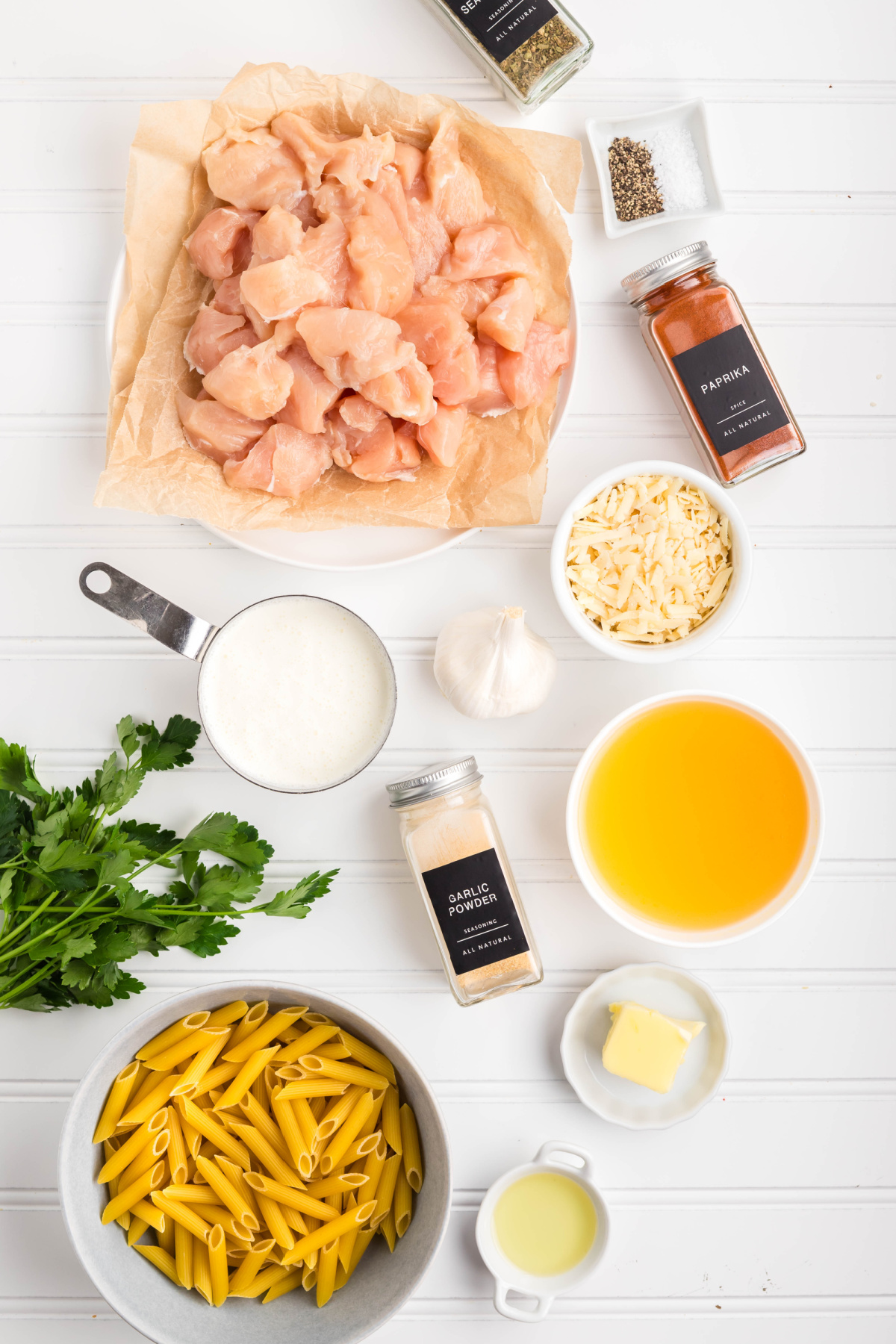
Ingredients
- Penne pasta – This was always penne. I was feeding a small army of teens and nobody needed to be downstairs trying to twirl fettuccine onto a fork. It was easy to make by the potful and worked with the garlic cream sauce, so penne won and never left.
- Boneless, skinless chicken thighs or breasts – I prefer chicken thighs because they’re juicier, have more flavor and forgive you if somebody walks into the kitchen and starts telling you a story while you’re cooking. Chicken breasts are fine, but pay attention because they don’t have the same tolerance for overcooking.
- Olive oil – Enough to brown the chicken in the skillet. Whatever the chicken leaves stuck to the bottom is coming with us when we make the sauce.
- Italian seasoning – This goes directly on the chicken along with the rest of the seasoning. Cream has a way of making underseasoned food taste even more underseasoned.
- Kosher salt and black pepper – Use enough. We have chicken, pasta and cream coming, and all three are perfectly capable of becoming blah without enough seasoning.
- Paprika – Mostly here for the chicken. It gives the chicken more color and adds a mild peppery flavor.
- Garlic powder – Yes, there are six cloves of fresh garlic coming, too. One doesn’t cancel out the other. Garlic powder seasons the chicken; fresh garlic belongs to the sauce.
- Butter – Once the chicken comes out, butter goes into the same skillet with the fresh garlic. This is the point where every teen within smelling distance would materialize in the kitchen.
- Fresh garlic – Six cloves. I suppose you could use less, but then we’d have to discuss why you chose a recipe called creamy garlic chicken pasta.
- Chicken broth – Pour it into the hot skillet and scrape up the browned bits the chicken left behind. That is flavor you paid for. Don’t leave it glued to the pan.
- Heavy cream – The chicken broth keeps it from becoming obscenely rich, and we don’t need flour or a roux involved in any of this.
- Parmesan cheese – Buy the wedge and grate it yourself. Pre-shredded Parmesan has its uses, but melting smoothly into a cream sauce is not one of its great gifts.
- Fresh parsley – A handful at the end adds fresh flavor, but most importantly, some color.
How to Make Creamy Garlic Chicken Pasta
Find the complete printable recipe with measurements in the recipe card at the BOTTOM OF THE POST.
- Step One (cook the pasta + season the chicken):
Bring a large pot of salted water to a boil and cook the penne according to the package directions until al dente. There’s no reason to stand around watching pasta boil. We have things to do. - Step Two (brown the chicken):
Heat the olive oil in a large skillet over medium heat and add the chicken. Season it with Italian seasoning, paprika, garlic powder, salt and pepper. Give it a chance to get some good color before you start moving it around, then cook until the chicken reaches 165°F (74°C). Chicken thighs give you more wiggle room; chicken breasts require more supervision. Leave everything stuck to the bottom of the skillet right where it is. We’re coming back for it. - Step Three (start the garlic cream sauce):
Reduce the heat to medium-low, then add the butter and fresh garlic to the same skillet. Cook the garlic for about a minute, stirring so it softens without browning. Pour in the chicken broth and scrape up the browned bits while it comes to a simmer. We already did the work to put the flavor in the pan. We’re not leaving it there. - Step Four (bring it all together):
Drain the penne and add it to the skillet. Reduce the heat to low, then pour in the heavy cream and add the freshly grated Parmesan. Toss everything together until the cheese melts and the garlic Parmesan cream sauce coats the chicken and gets itself into every available piece of penne. Keep the sauce below a boil once the cream and Parmesan go in so it stays smooth. If the sauce looks a little loose at first, give it a minute before you start messing with it. - Step Five (finish + serve):
Once the sauce is creamy and coating the pasta but still has movement to it, take the skillet off the heat and add the fresh parsley. Taste it before adding more salt. Serve it hot because the sauce is at its creamiest right out of the skillet.

Recipe Tips
- Give the chicken a chance to brown before you start stirring it around. The browned stuff left in the skillet become part of the garlic cream sauce once the chicken broth goes in, so don’t hurry this part.
- Keep the heat under control once the fresh garlic goes into the butter. Garlic can go from fragrant to bitter while you’re turned around looking for the Parmesan, and six cloves of burnt garlic is a fairly committed mistake.
- Grate the Parmesan yourself and add it over low heat. Pre-shredded cheese often contains anti-caking ingredients that interfere with smooth melting, and this sauce doesn’t need that kind of trouble.
- Don’t wait for the sauce to look thick in the skillet before taking it off the heat. The Parmesan will continue thickening it, and the penne keeps absorbing sauce as it sits. I would much rather have a garlic cream sauce that looks a little loose in the pan than one that turns into cement halfway through dinner.
- Chicken thighs are the more lenient choice if you tend to get distracted while you cook. Chicken breasts work too, but because the pieces are small, they can go from juicy to dry quickly. Either one is done at 165°F (74°C), so there’s no need to start cutting chicken open and consulting the juices like tea leaves.

Storage and Reheating
- Creamy pasta is happiest the first night, but leftovers are very much worth keeping. Store the chicken and penne in an airtight container in the refrigerator for up to 3 days.
- The garlic Parmesan sauce will get much thicker in the refrigerator because the pasta keeps absorbing it. Add a splash of chicken broth or cream before reheating, then warm it slowly on the stove or in short intervals in the microwave, stirring along the way. You’re not trying to cook it again. You just want the sauce to become saucy again.
- I don’t freeze this one. Cream sauces separate after freezing and thawing, and cooked pasta rarely comes out of the experience improved.

FAQs
- Can I use chicken breasts instead of chicken thighs?
Yes. Boneless, skinless chicken breasts work fine in this creamy chicken pasta. Cut them into similarly sized pieces so they cook at the same rate, and watch the cooking time since breast meat is less forgiving than chicken thighs. - Can I use a different pasta instead of penne?
Rigatoni, ziti, fusilli or another short pasta works well with this garlic Parmesan cream sauce. I still like penne best, but any short pasta with ridges, curves or hollow centers gives the sauce somewhere to go. - Can I add vegetables to creamy garlic chicken pasta?
Yes, but I’d choose something that isn’t going to dump a lot of water into the sauce. Spinach can go in right at the end, broccoli is easy to cook separately and add with the pasta, and mushrooms can be browned before you cook the chicken. Zucchini wouldn’t be my first choice unless you cook off its moisture separately. - Can I make the cream sauce lighter?
You can use half-and-half in place of the heavy cream, but the sauce will be thinner and less rich. I wouldn’t use regular milk. At some point we have to accept that we’re cooking creamy garlic chicken pasta and let it be creamy garlic chicken pasta. - Why is my Parmesan cream sauce grainy?
Usually the skillet is too hot or the Parmesan isn’t melting smoothly. Lower the heat before adding the cheese, use Parmesan you’ve grated from a wedge and don’t let the sauce boil once the cheese goes in. A screaming-hot skillet and a bag of pre-shredded Parmesan are not friends of this operation. - What if my garlic cream sauce is too thick?
Add chicken broth a tablespoon or two at a time until the sauce is where you want it again. This is especially useful if the pasta sat for a few minutes before serving because penne will continue drinking the sauce while everyone is taking their time getting to the table. - What if the sauce is too thin?
Give it another minute over low heat before doing anything. The Parmesan and pasta will continue thickening the sauce as it sits. If it really needs help, add more freshly grated Parmesan rather than boiling the heck out of the cream. - Can I make creamy chicken pasta ahead of time?
I wouldn’t make the entire dish ahead if you can avoid it. The pasta keeps absorbing the garlic cream sauce as it sits, so this is better made close to serving. You can cut and season the chicken, mince the garlic, grate the Parmesan and measure everything ahead of time, which gets most of the annoying work out of your way anyway.

From My Kitchen Notes
Small observations from the margins.
- Some divisions exist before anyone thinks to name them.
- I can make room for two things without choosing a side.
- It’s easy to feed the same table without giving everyone the same thing.
- I used to think recipes became permanent because they were exceptional. Most of them last because life keeps requiring them.
- What gets repeated often enough eventually becomes instinct.
- Repetition has ambitions of its own.
- There are things I started making for other people that eventually became mine.
- A sauce can change completely depending on what it picks up from the bottom.
- Not everything that thickens with time needs fixing.
- Some recipes took me ten years to finish because I didn’t realize they were being written.
- What disappeared from the table can still remain part of the recipe.
- I rarely know the last time I’m making something for the reason I started making it.
- Nobody warned me that one day I’d make something in the same kitchen, with the exact pan, and realize the quantity was never the recipe. The quantity was my life.
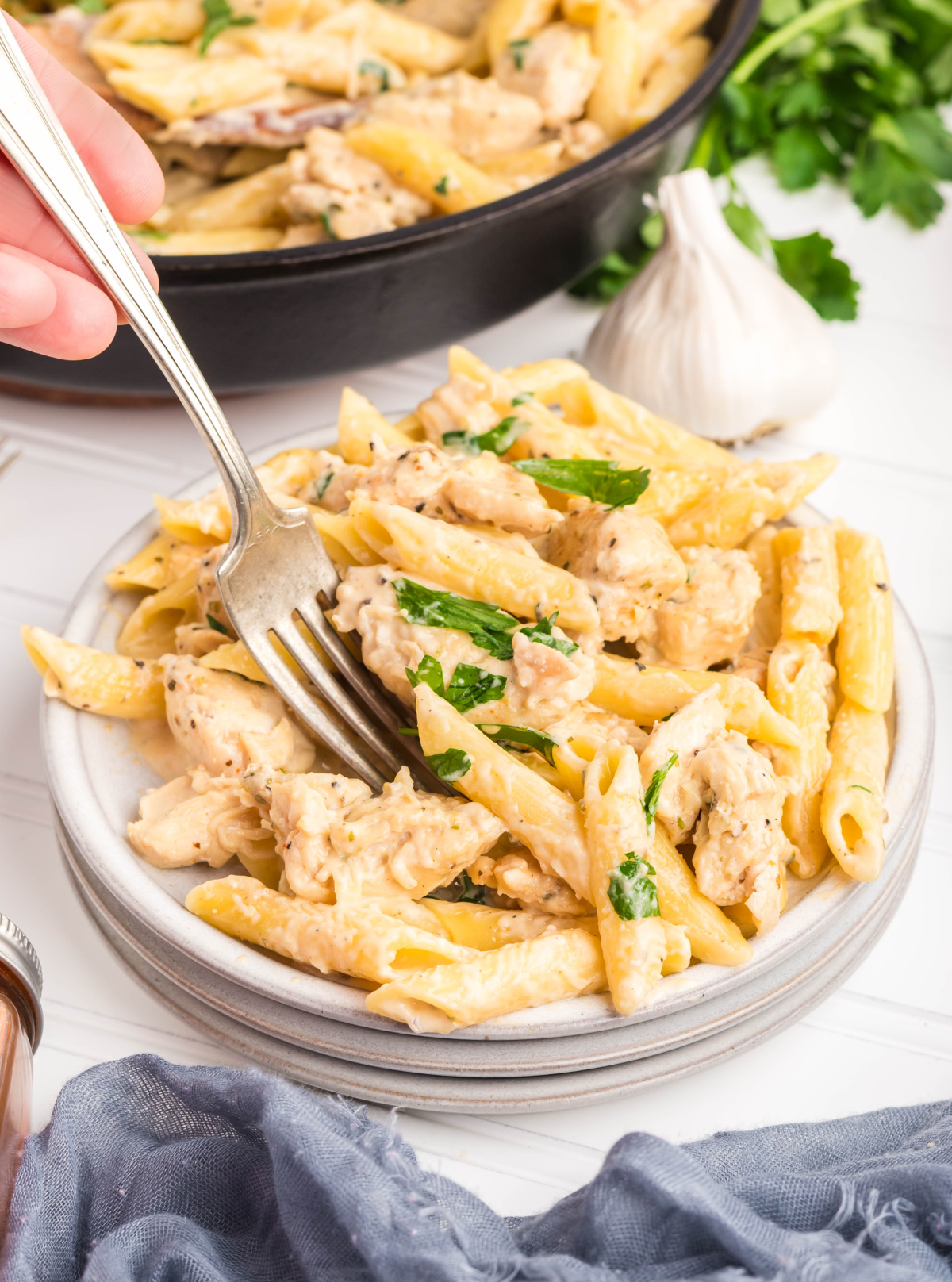
More Pasta for Whoever Shows Up
- Chicken Philly Cheesesteak Pasta – Tender chicken, peppers, melted cheese.
- Cacio e Pepe – Pecorino Romano, toasted black pepper.
- Mushroom Fettuccine – Sautéed mushrooms, creamy Parmigiano sauce.
- Blackened Shrimp Pasta – Spicy shrimp, creamy sweet corn.
- Fettuccine Alfredo – Classic creamy sauce, ready quickly.
- French Onion Pasta – Caramelized onions, melted Gruyere.
This post may contain affiliate links. Please read my disclosure policy.

Creamy Garlic Chicken Pasta
Equipment
- large skillet A 12-inch skillet gives the chicken enough room to brown and leaves enough surface area for reducing the sauce.
- large pot Gives the penne enough water and room to cook evenly without sticking together.
- measuring cups and spoons For measuring the sauce ingredients and seasonings accurately.
- Colander For draining the cooked penne before adding it to the skillet.
- microplane grater Freshly grated Parmesan melts more readily into the cream sauce than pre-shredded cheese.
- instant-read thermometer The most reliable way to confirm the chicken has reached 165°F (74°C).
Ingredients
- 8 oz (227 g) dry penne pasta
- 1 tbsp (15 ml) olive oil
- 1 lb (454 g) boneless, skinless chicken breasts or thighs cut into bite-size pieces
- 1 tsp (3 g) Italian seasoning
- ½ tsp (3 g) kosher salt
- ½ tsp (1 g) black pepper
- ½ tsp (1 g) paprika
- ¼ tsp (0.75 g) garlic powder
- 2 tbsps (28 g) butter
- 6 cloves garlic minced
- 1 cup (240 ml) low-sodium chicken broth
- 1 cup (240 ml) heavy cream room temperature
- ½ cup (~45 g) freshly grated Parmesan cheese
- 2 tbsps (8 g) chopped fresh parsley
Instructions
- Bring a large pot of salted water to a boil. Cook the penne according to the package directions until al dente. Drain and set aside.8 oz (227 g) dry penne pasta
- While the pasta cooks, heat the olive oil in a large skillet over medium heat. Add the bite-size chicken pieces and season with the Italian seasoning, kosher salt, black pepper, paprika, and garlic powder. Cook for about 7 minutes, stirring occasionally, until the chicken is browned and reaches an internal temperature of 165°F (74°C).1 tbsp (15 ml) olive oil, 1 lb (454 g) boneless, skinless chicken breasts or thighs, 1 tsp (3 g) Italian seasoning, ½ tsp (3 g) kosher salt, ½ tsp (1 g) black pepper, ½ tsp (1 g) paprika, ¼ tsp (0.75 g) garlic powder
- Reduce the heat to medium-low. Add the butter and minced garlic to the skillet and cook for about 1 minute, stirring frequently, until the garlic is fragrant. Keep the heat moderate so the garlic softens without browning.2 tbsps (28 g) butter, 6 cloves garlic
- Pour in the chicken broth and scrape the bottom of the skillet to release the browned bits from cooking the chicken. Bring the broth to a simmer and cook for 2 to 3 minutes to reduce slightly.1 cup (240 ml) low-sodium chicken broth
- Add the drained penne to the skillet and toss it with the chicken and broth.
- Reduce the heat to low. Pour in the room-temperature heavy cream and add the Parmesan. Stir until the cheese has melted and the sauce is smooth. Avoid boiling the sauce after adding the cream and Parmesan, which can cause the dairy to separate.1 cup (240 ml) heavy cream, ½ cup (~45 g) freshly grated Parmesan cheese
- Continue cooking over low heat for 1 to 2 minutes, tossing the pasta frequently, until the sauce has thickened enough to coat the penne. Remove from the heat. The sauce will continue to thicken slightly as it stands.
- Sprinkle with chopped parsley and serve immediately.2 tbsps (8 g) chopped fresh parsley
Notes
- Chicken thighs are more forgiving in this recipe and stay tender if they cook a little longer. Chicken breasts also work, but check them early and remove the skillet from higher heat once they reach 165°F (74°C).
- Bring the heavy cream closer to room temperature while preparing the other ingredients. Adding very cold cream to a hot skillet increases the chance of the sauce separating.
- Grate the Parmesan from a block rather than using pre-shredded cheese. Packaged shredded Parmesan often contains anti-caking ingredients that prevent it from melting as smoothly into a cream sauce.
- Keep the heat low after adding the heavy cream and Parmesan. A hard boil can cause the sauce to separate or become grainy.
- The sauce should still look slightly loose when the skillet comes off the heat. The Parmesan and pasta will continue to absorb and thicken the sauce as it stands.
- Refrigerate leftovers in an airtight container for up to 2 days. Reheat over low heat with a small splash of chicken broth or cream to loosen the sauce.
Nutrition
Have you made this Creamy Garlic Chicken Pasta? I’d love to hear how it turned out — leave a comment below and let me know.
As an Amazon Associate and member of other affiliate programs, I earn from qualifying purchases.
Winnie says
Made this garlicky pasta tonight and we loved, loved it! It was so easy to have it ready before everyone got home. Thanks for the great recipe.
Sara says
I agree with you it was so good. Everyone loved every single bite. I’m going to make it again this week.
Sherri Scott says
My picky 6 year old is skinny as a fence post. Kid will not eat many things but he asks for this on repeat. So its in the weekly rotation . At first I was intimidated to make it but the second time was super easy. My daughter refused because she is at a hating cheese phase but the rest of the family loved it. Thank you.
Cathy Pollak says
I really appreciate you taking the time to leave this. The first time can feel like a lot with the garlic and sauce, but once you know the steps, it settles into something manageable. And I completely get the cheese phase. Happy to hear it worked for your son and most of the crew.
Sweet Clover says
I made it😋!! Delish everyone said 🤤, this is already in my book, thank you so much for sharing.
Cathy Pollak says
So happy you loved it. Thank you!
Kaelos says
This recipe has a fantastic flavor foundation! I’ll definitely be making it again, with a few small adjustments to better match my wife’s and my preferences; just a touch more garlic powder and salt to deepen the flavor, and an extra splash of cream to enrich the sauce. It came together effortlessly on a hectic weeknight, and I really appreciate that everything cooks in a single skillet. All in all, we loved it and can’t wait to make it again soon!
Cathy Pollak says
So happy you’ve made it work for you!
Susan says
This was so easy to make and we all loved the taste. I added some fresh spinach and a cup of frozen peas and also increased the broth and cream. Delicious.
Cathy Pollak says
Sounds like a great version. Thanks for letting me know.
Margot Morris says
Just finishing my previous post
I wasn’t prepared for how much my husband loved this dish
Made sure that I wrote the recipe down
It was an easy dish to make
That’s you for making this simple but OHH so tasty
Cathy Pollak says
So happy to hear this, thank you.
carol miller says
I would like to add collard greens to this dish. When do I add them?
Cathy Pollak says
I’d add the collard greens right after the garlic. Once the chicken is cooked, stir in the butter and garlic and cook for about a minute. Then add the thinly sliced collard greens and let them cook for 3 to 5 minutes, stirring occasionally, until they soften and begin to wilt. After that, pour in the chicken broth and continue with the recipe as written.
Since collards are sturdier than spinach, they need a little extra time in the pan. Just be sure to remove the tough center stems and slice the leaves into thin ribbons so they cook evenly and mix well with the pasta.
Marni Y says
Loved making this with chicken thighs! The penne and chicken together was so delish.
Charles Meekings says
I’ve had this recipe sitting in my downloaded recipes folder for a while, but I was never particularly motivated to make it becUse it seemed just a little too basic. But after waking up very groggy from a mid-afternoon nap that ended with questions from my wife and kids about what’s for dinner, this recipe came to mind. Well, now I have the kids asking me to put this on the regular mid-week recipe list. They loved it and it comes together so quickly that it’s ideal.those those evenings when you’re not sure if you’re really up to cooking and pizza delivery is sounding pretty tempting, but you know you have ingredients in the fridge.
Cathy Pollak says
I love this because that is pretty much the exact kind of night this recipe was made for. I spent years making it for a house full of hungry kids when I needed dinner to be easy but still wanted to put something good in front of everyone. I’m so glad your kids loved it enough to put it on the regular midweek list. Thanks so much for coming back to tell me.