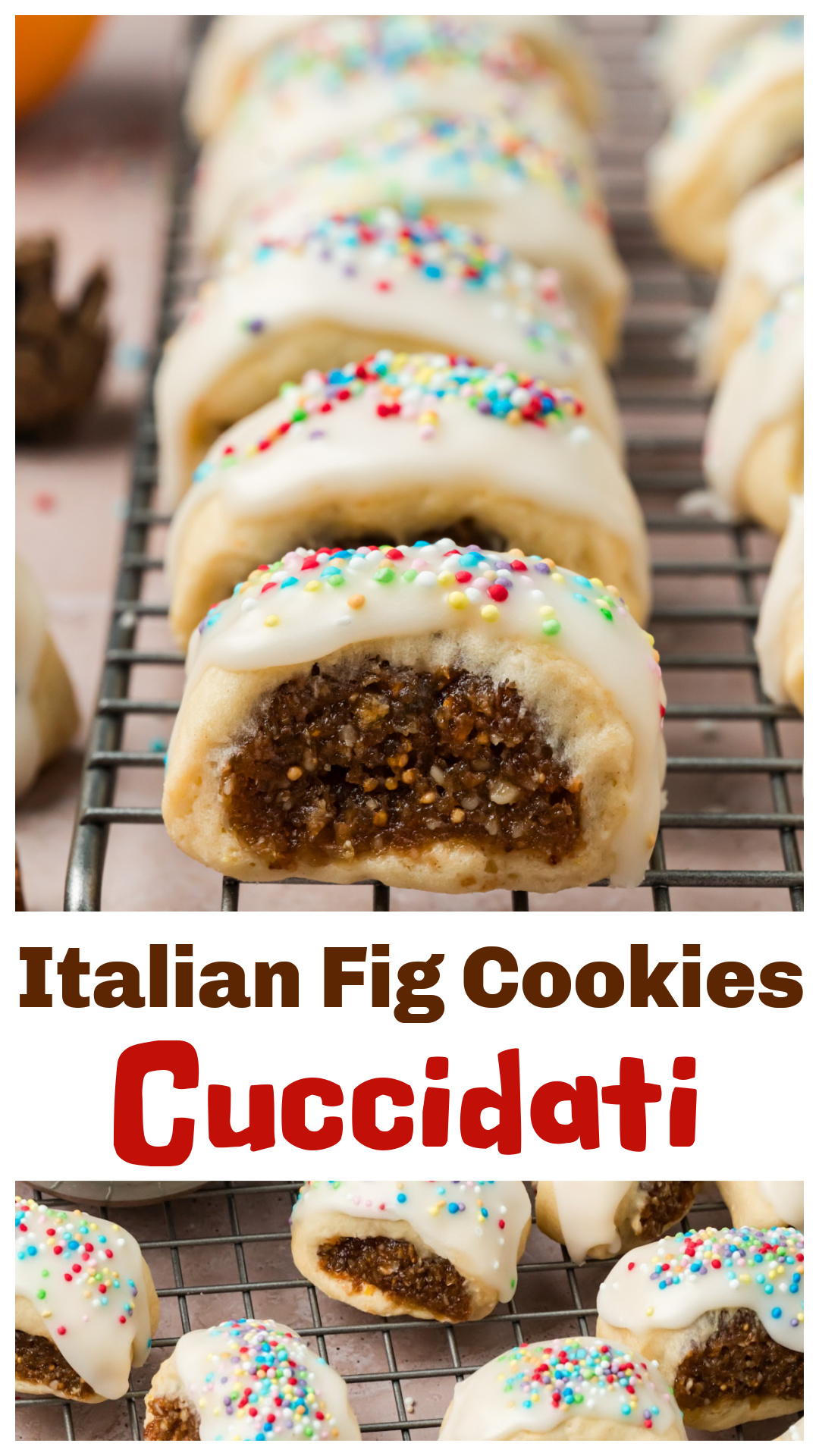
These Italian fig cookies are filled with dried figs, dates, golden raisins, walnuts, orange, and sweet Marsala, all wrapped in a tender, buttery dough. Known as cuccidati, they’re dipped in vanilla glaze and covered with colorful nonpareils. They’re a favorite for Christmas cookie trays.
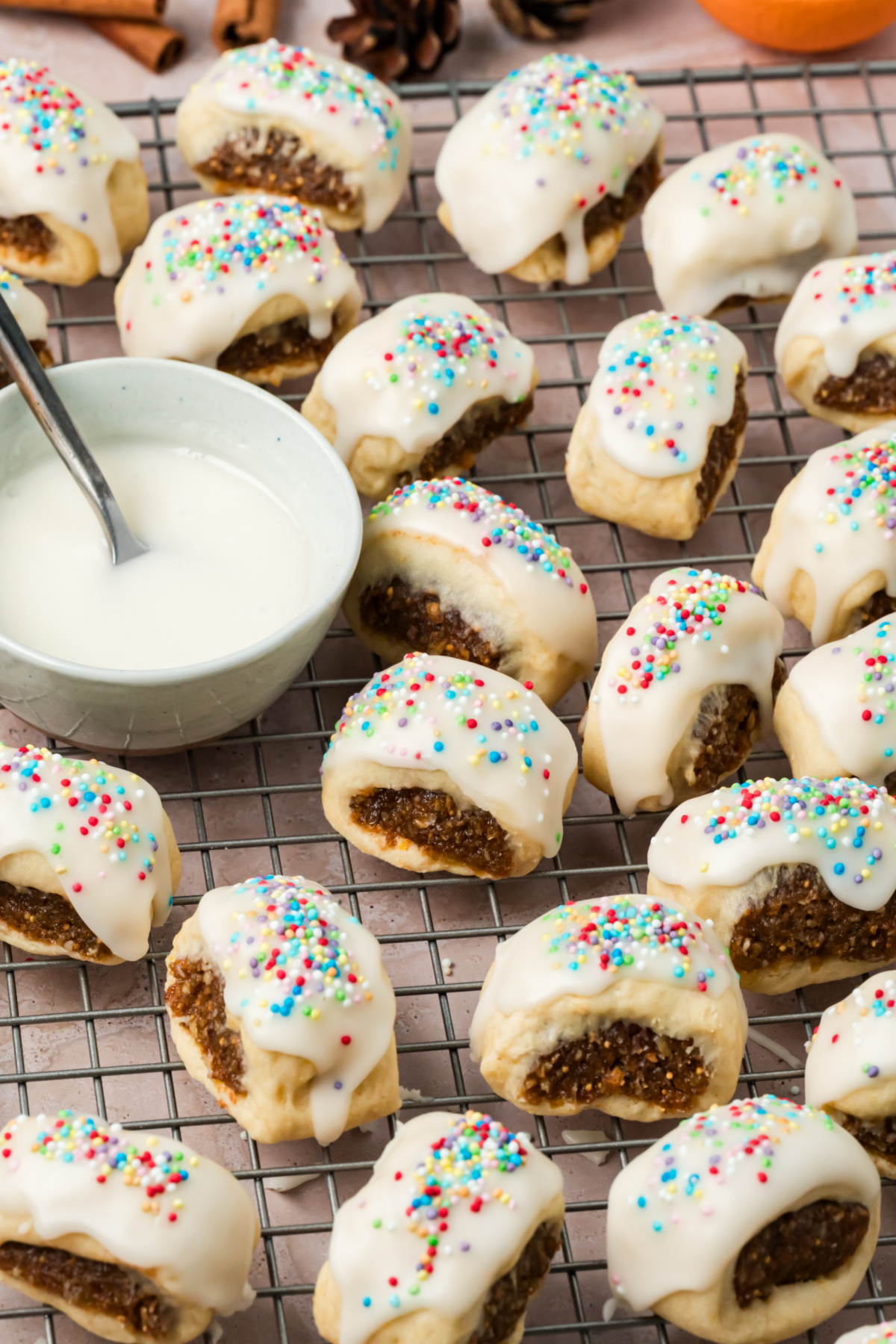
Italian Fig Cookies with Dried Fruit and Walnuts
I didn’t grow up eating Italian fig cookies, and I don’t remember knowing they existed until I started noticing them in Italian bakeries, sometimes in New York and especially in Boston. Funny, I don’t even recall seeing them in Sicily, but I was never there during the holidays.
The flavors inside these cookies are familiar things I grew up eating, and is what initially piqued my interest. I’ve always gravitated towards things like poppy seed breads, figs, dates, raisins, and walnuts. All the dense, nutty, dried-fruit flavors are completely normal food to me. It’s probably why I also love fruitcake, which seems to trigger everyone. Fresh figs, dried figs, something with figs baked into it. I’ve never need any extra convincing once figs are involved.
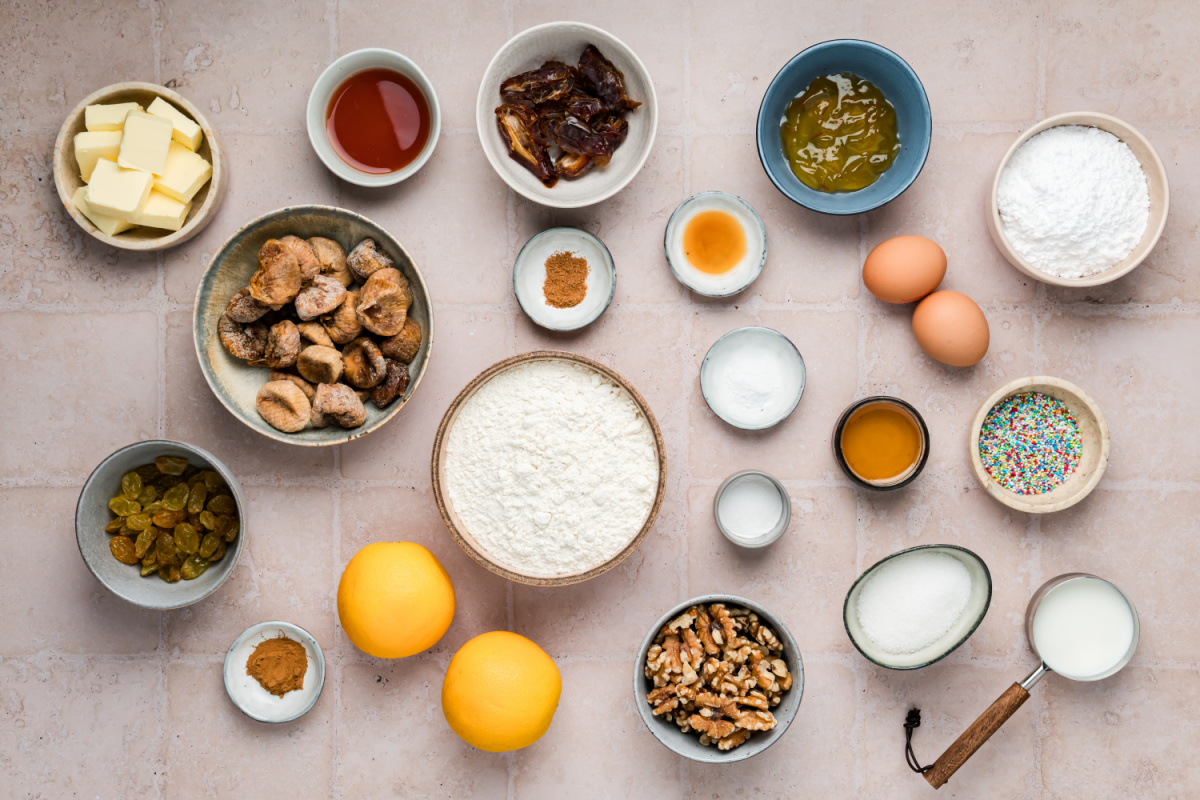
Once I came across cuccidati, I started looking for them and eventually decided to learn how to make them. They have a lot going on in the middle, which is why I love them. they’re full of figs, dates, golden raisins, walnuts, orange, cinnamon, nutmeg, sweet Marsala, and enough honey and marmalade to hold them together. The filling isn’t smooth like a Fig Newton, thank gawd, and it isn’t trying to be. You can taste the walnuts and see the fig seeds, which is what I like.
These cookies take some time, but they’re not difficult. I like making the dough and fig filling one day, then rolling, filling, baking, glazing, and adding the rainbow nonpareils the next. I also make mine big-heartedly filled because that’s part of my personality. I will not be wrapping a tiny layer of fig paste in pastry. Food, life, and especially cookies are about abundance. With these Italian fig cookies, I want thin pastry, lots of filling, and vanilla glaze and sprinkles over the top. There was never any other way.
The Decisions Behind This Recipe
- I make these Italian fig cookies over two days because there’s dough to make, filling to process, cookies to roll and shape, then baking, glazing, and sprinkling. It’s not hard, but I like making them a lot more when I don’t try to cram every part into one afternoon. I make the dough and filling the day before, then refrigerate them separately overnight. They’re both easier to handle cold, and the filling can even be made up to a week ahead if I’m deep in Christmas-cookie mode.
- Cold butter is the gateway to the correct pastry texture. I cut it into the flour in the food processor before adding the eggs, milk, vanilla, and orange zest. The finished dough is tender and buttery, not soft and cakey like the outside of a Fig Newton. I’ve never been a fan of Fig Newtons. These are closer to a Pop-Tart in the pastry department, although the filling is a completely different thing.
- The fig filling needs to be moist enough to press into a log without crumbling, but not loose enough to spread all over the dough when trying to wrap it up. The figs, dates, golden raisins, walnuts, marmalade, honey, and Marsala get processed into a sticky mixture that holds together when you press it. That’s the texture you’re looking for.
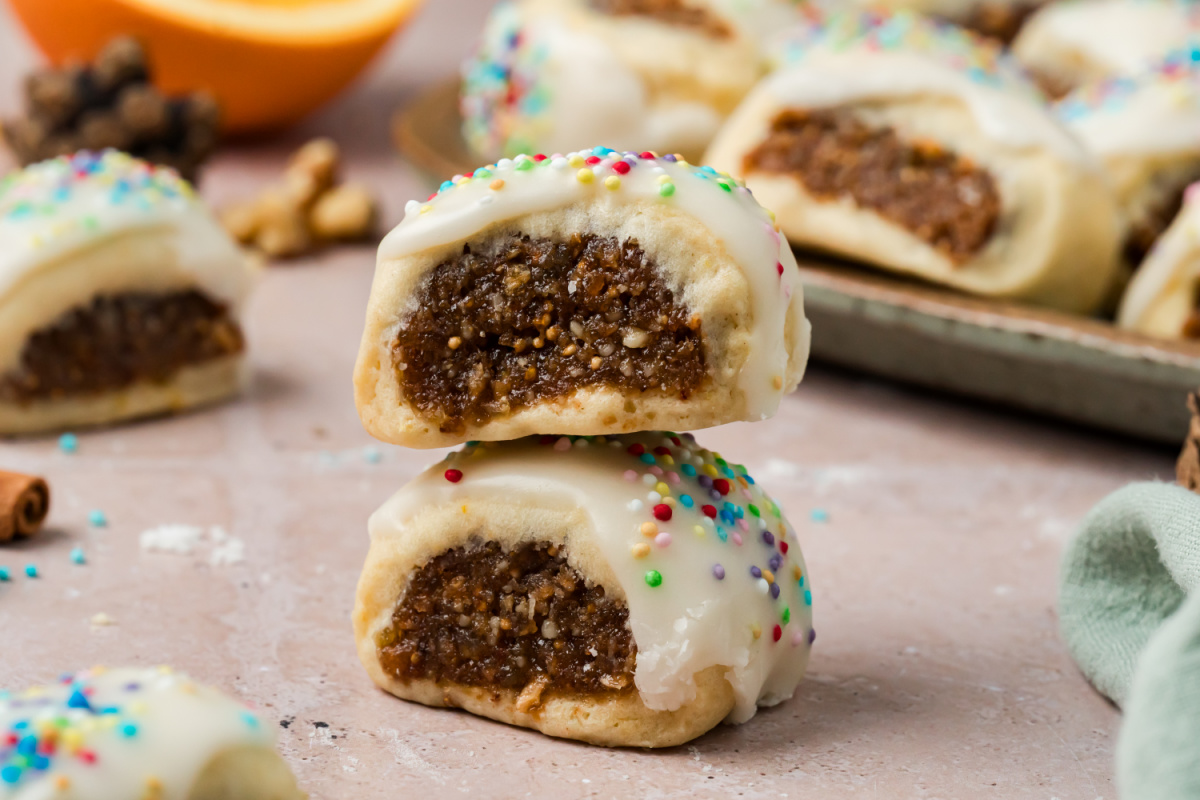
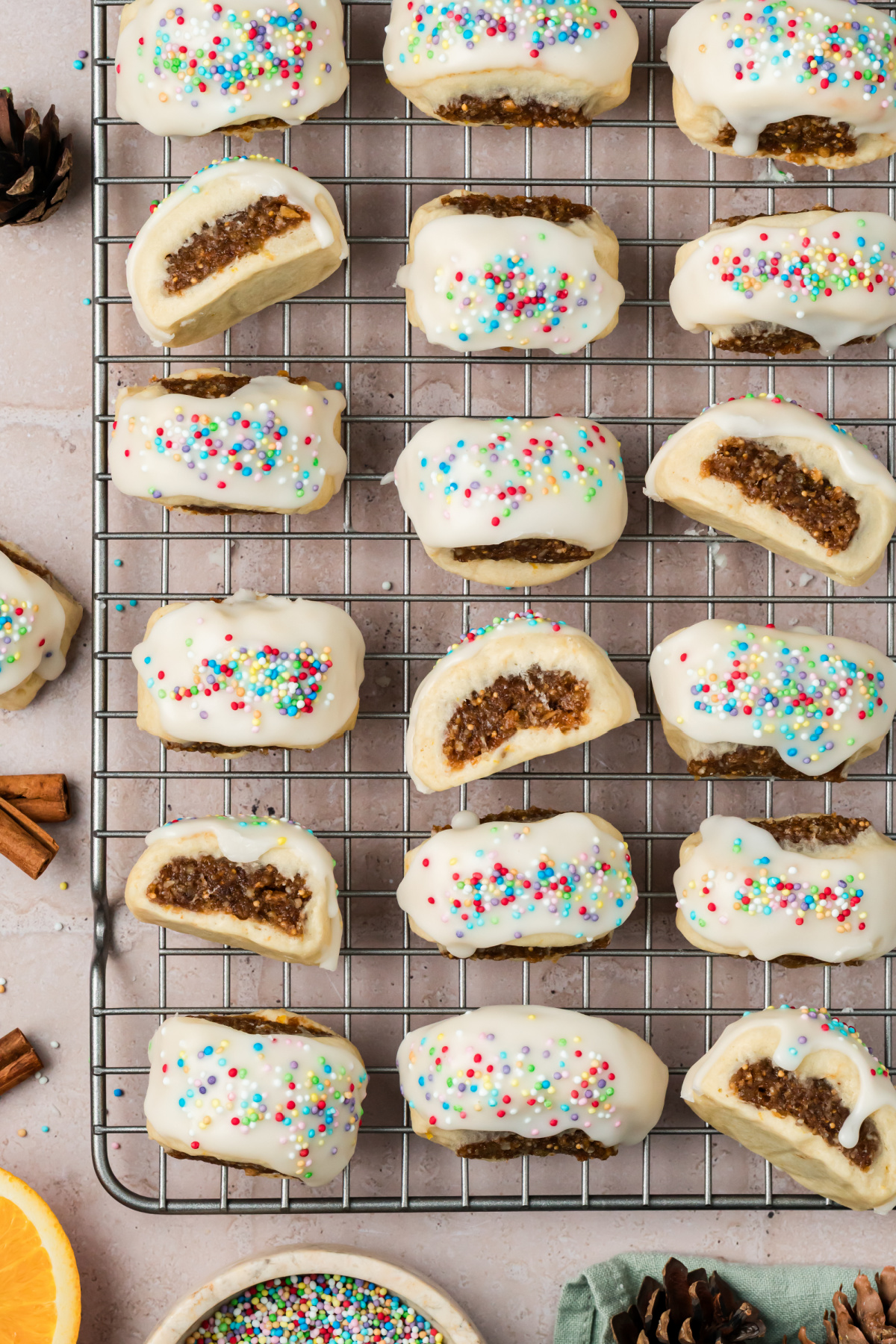
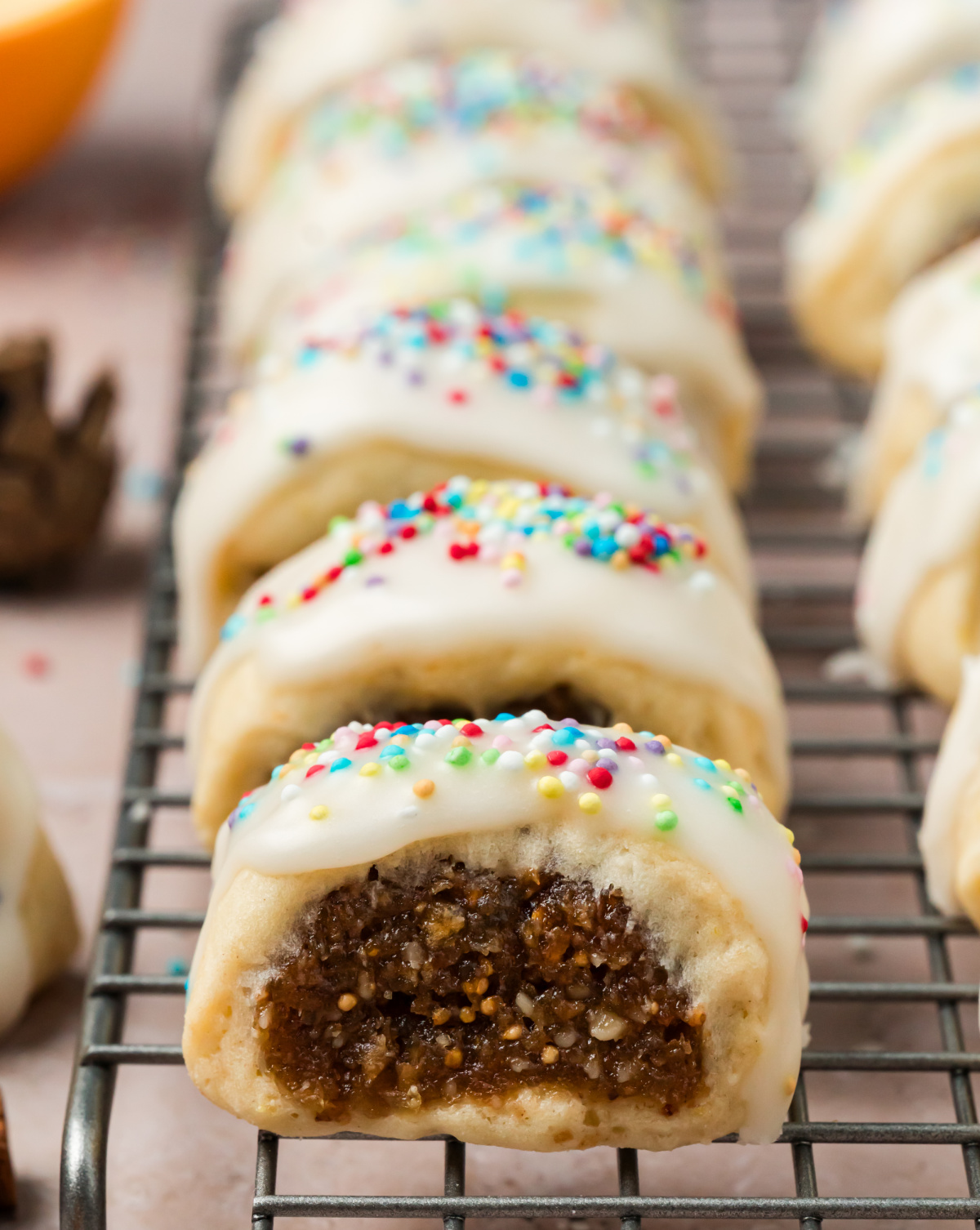
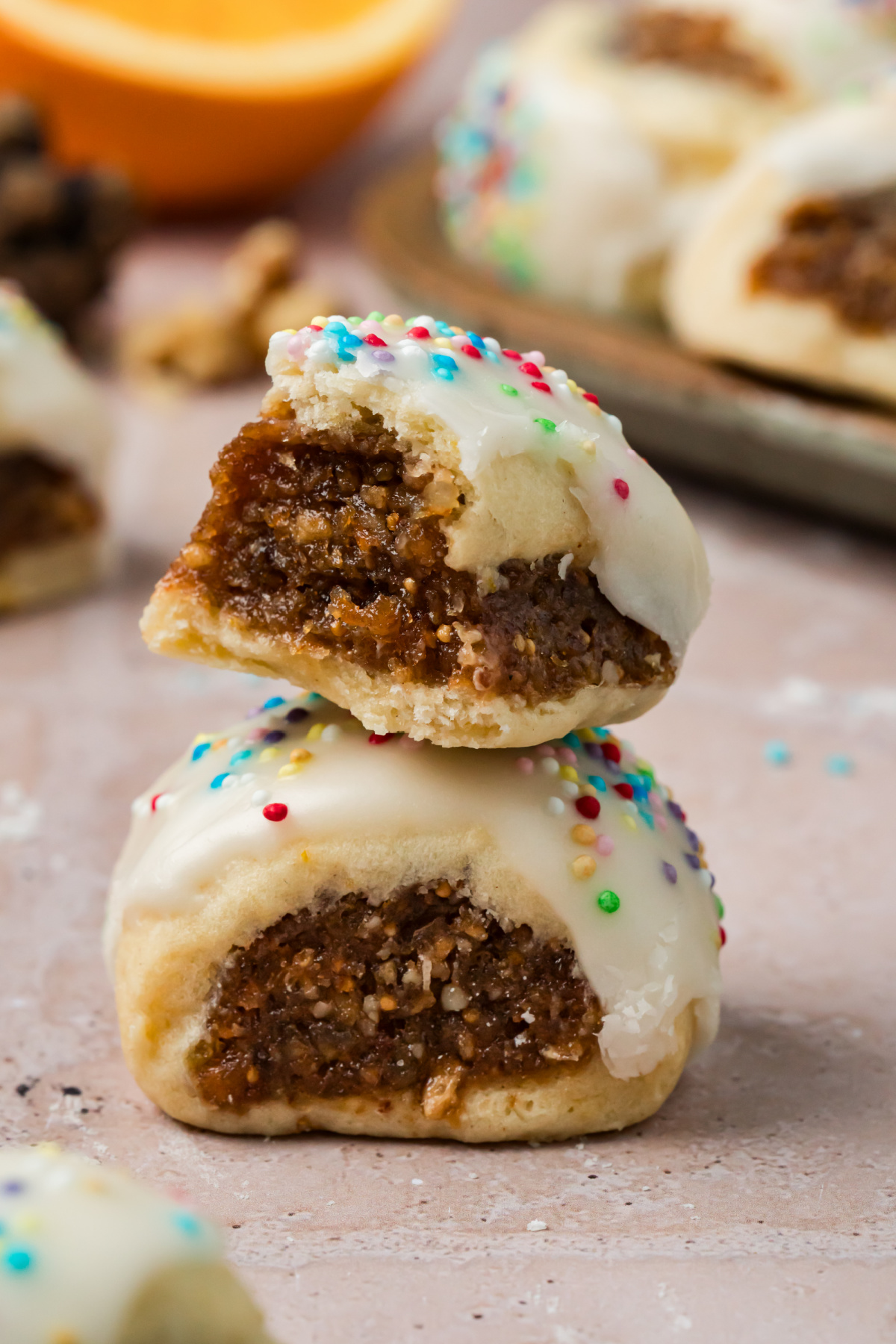
- I roll the dough to about ⅛ inch because I want more filling than pastry in each cookie. The dough should be thin enough that the dried fruit and walnut filling is the main thing you taste, but strong enough to fold over it without tearing. The cut-open cookies in the photos are the goal.
- I divide the dough into four portions before refrigerating it so I can take out only what I’m ready to roll. I can roll and fill one piece while the other three stay cold in the fridge. Trying to work with all the dough at once means the last part gets soft and sticky. It’s too much drama. Don’t do it.
- The tops of these cookies should still look pale when they’re finished baking, even though the bottoms and sides have taken on some color. If you wait for the tops to brown, the pastry will be dry, and that’s the opposite of what I want. These cookies have a dense, moist filling already. The dough needs to stay tender enough to hold up its end of the bargain.
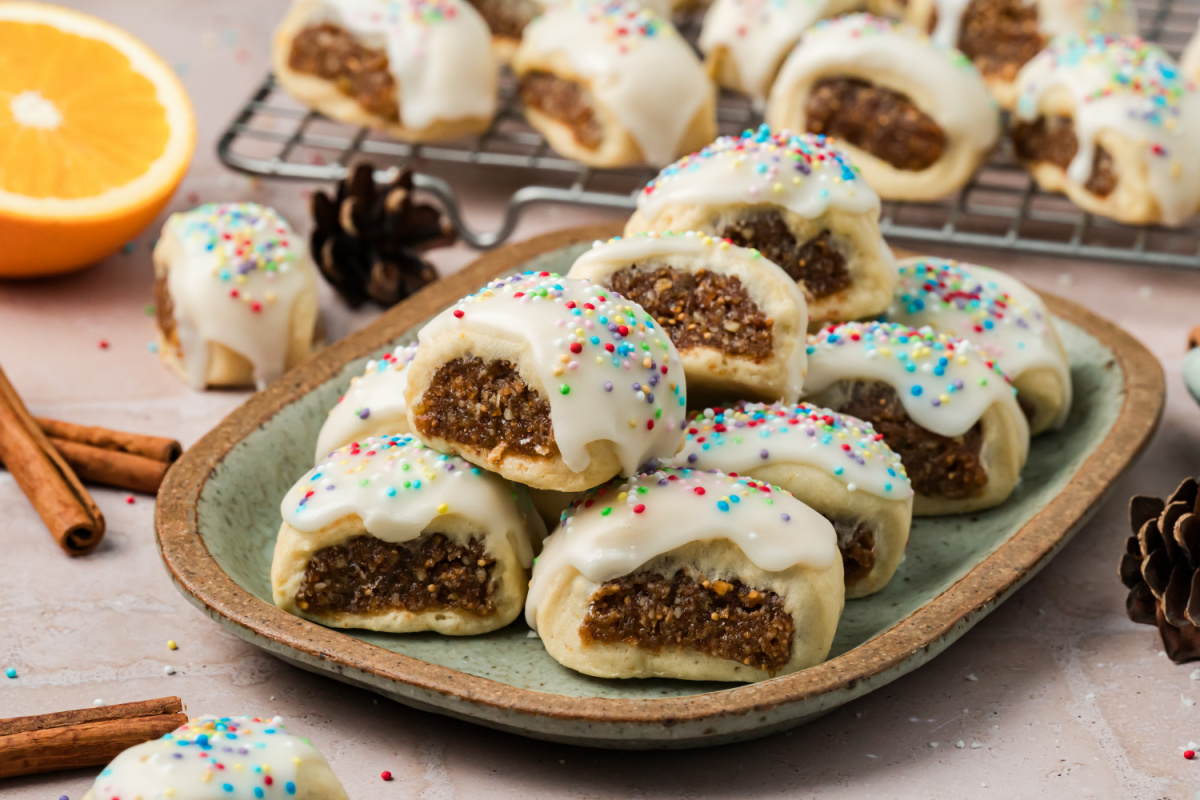
Ingredients
- All-purpose flour, granulated sugar, baking powder, and salt – These make the pastry dough that wraps around the filling. It needs to be tender when baked but strong enough to roll thin and fold around the filling without tearing.
- Cold unsalted butter – Keep the butter cold and cut it into cubes before adding it to the food processor. Cutting cold butter into the flour helps give the pastry its tender texture.
- Eggs, whole milk, and vanilla extract – These bring the dough together and give it enough flexibility to roll around the fig filling. You’ll also use milk and vanilla again in the glaze.
- Fresh orange zest – Orange zest goes into both the dough and the fig filling, so the orange flavor doesn’t vanish into the dried fruit, nuts, and glaze.
- Dried figs, pitted dates, and golden raisins – This is the fruit base of the filling. Remove the hard stems from the figs, and look for dried fruit that feels soft and pliable.
- Walnuts – I use lots because they’re my favorite, and I like seeing and tasting them in the filling. They also keep the filling from becoming one solid mass of fruit paste.
- Orange marmalade, honey, and sweet Marsala wine – These add orange flavor, sweetness, moisture, and enough stickiness to hold the filling together. Dark rum or brandy can be used in place of Marsala, or use orange juice if you’d rather leave out the alcohol.
- Ground cinnamon and nutmeg – The cinnamon is doing a lot, with nutmeg only in the background.
- Confectioners’ sugar – This becomes the white vanilla glaze that gets dipped over the cooled cookies.
- Rainbow nonpareils – Add these while the glaze is still wet so they stay on the cookies. Italian fig cookies without colorful sprinkles look unfinished to me.
How to Make Italian Fig Cookies (Cuccidati)
Find the complete printable recipe with measurements in the recipe card at the BOTTOM OF THE POST.
- Step One (make the pastry dough)
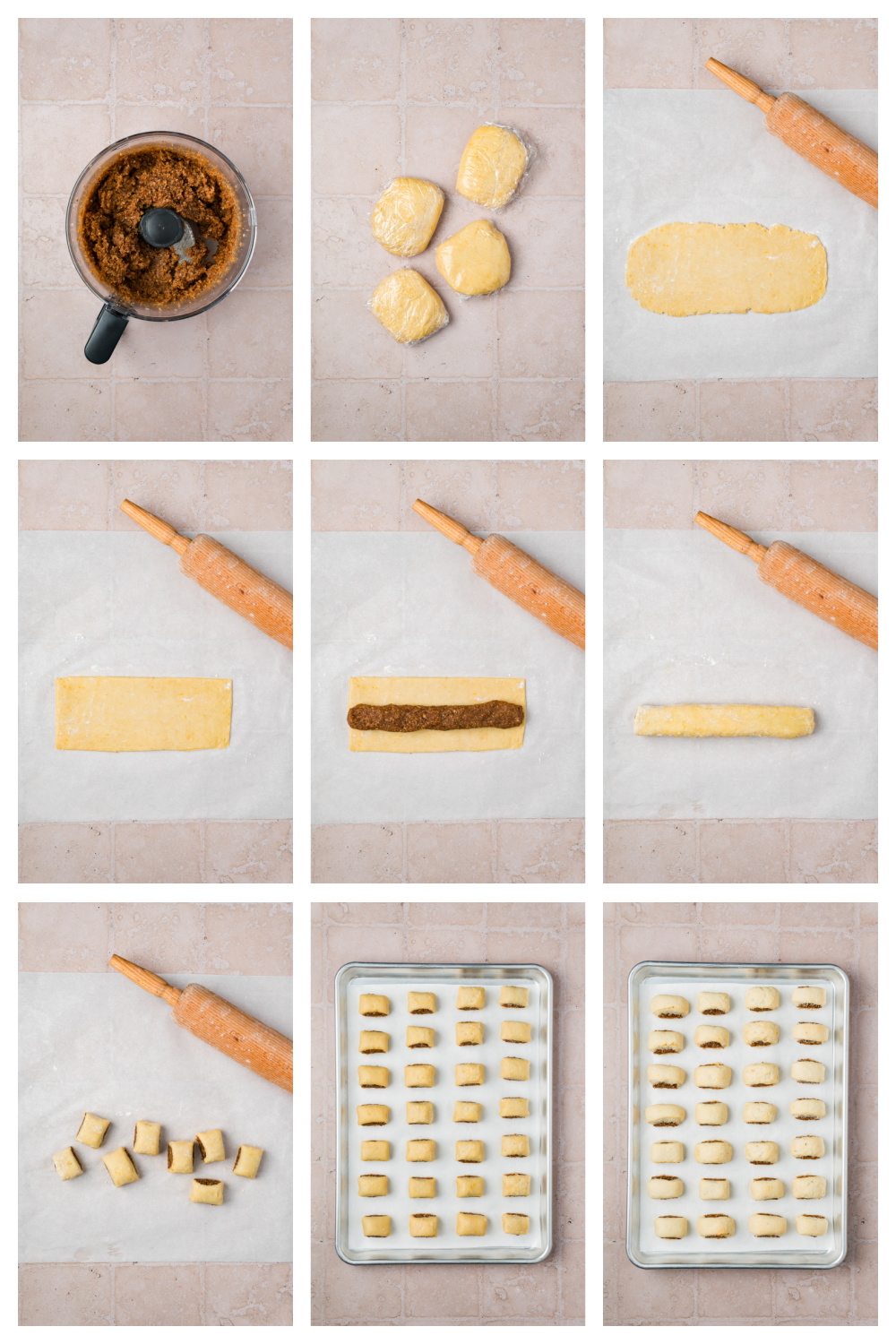
Add the flour, sugar, baking powder, and salt to a food processor, then pulse a few times to mix everything together. Add the cold, cubed butter and pulse until it looks like coarse crumbs. Add the eggs, milk, vanilla, and orange zest, then pulse until the dough begins to gather together. Stop processing as soon as it does. Transfer the dough to a lightly floured surface, divide it into four equal portions, and shape each into a disk. Wrap them separately and refrigerate for at least 1 hour, preferably overnight. - Step Two (prepare the fig filling)
Remove the hard stems from the dried figs, then add the figs, dates, golden raisins, and walnuts to the food processor. Pulse until everything is finely chopped, then add the orange marmalade, honey, sweet Marsala, orange zest, cinnamon, nutmeg, and salt. Process until the mixture becomes a thick, sticky paste that holds together when pressed, with some of the chopped fruit and walnuts still visible. It should be cohesive enough to shape into a log without crumbling, but not so wet that it spreads when you wrap the dough around it. If it’s too dry to shape, add another teaspoon of Marsala and pulse again. Refrigerate the filling until you’re ready to use it. You can make it up to a week ahead. - Step Three (roll and fill the dough)
Preheat the oven to 350°F and line two large baking sheets with parchment paper. Take one dough disk from the refrigerator and roll it on a lightly floured surface into a long rectangle about ⅛ inch thick, leaving the other disks chilled. Shape one-quarter of the fig filling into a log and place it lengthwise down the center of the dough. I want enough dough to wrap around the filling, but not so much that it’s a pastry tube with a vague fig suggestion inside. We want abundance. - Step Four (shape and cut the cookies)
Fold one long side of the dough over the filling, then fold the other side over it so the dough overlaps slightly. Press the seam closed, using a dab of water if needed. Turn the log seam-side down and lightly press the top and sides to even out its shape. Cut crosswise into 1-inch cookies and arrange them on the prepared baking sheets about an inch apart. Repeat with the remaining dough and filling. If the dough becomes too soft to handle, refrigerate it for a few minutes before continuing. - Step Five (bake and cool the cookies)
Bake for 12–15 minutes, until the cookies are set and the bottoms and sides are lightly golden. The tops should still look pale. Let the cookies cool on the baking sheets for about 5 minutes, then transfer them to a wire rack to cool completely. Glazing warm cookies will make the icing thin out and slide off. - Step Six (glaze and decorate)
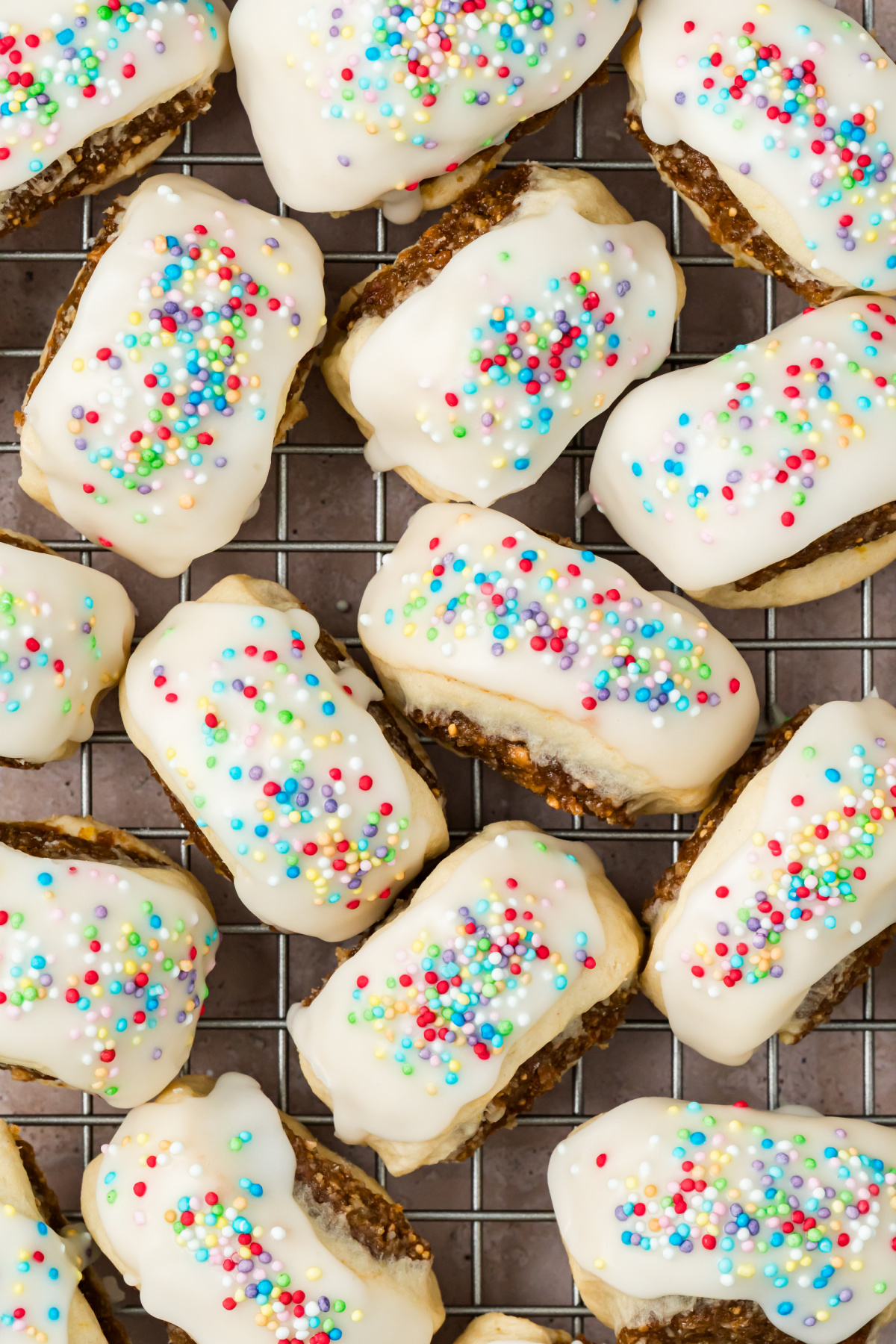
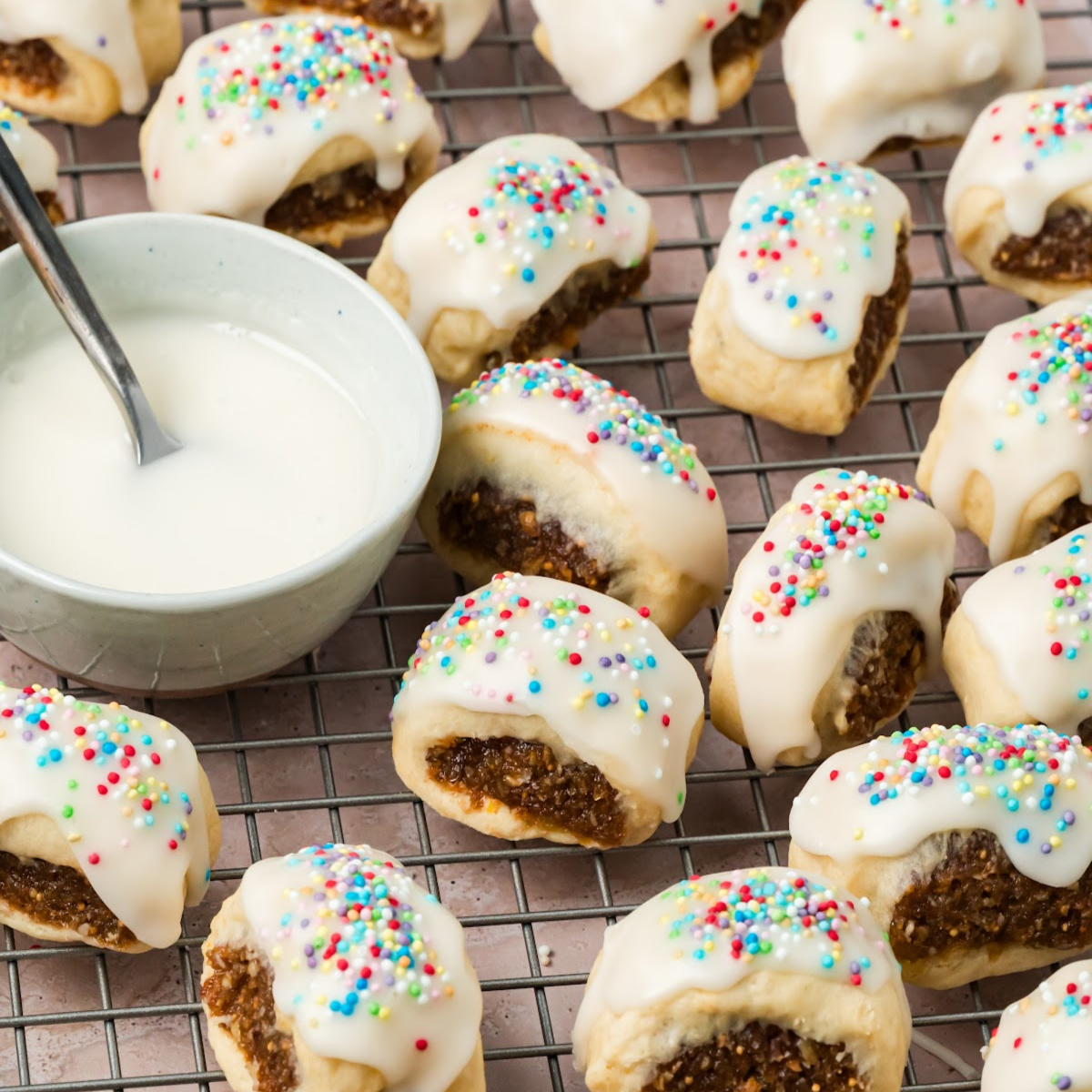
Whisk the confectioners’ sugar, milk, and vanilla until smooth. The glaze should coat the tops of the cookies without being so thick that you have to spread it with a knife. If needed, add more milk ½ teaspoon at a time. Dip the top of each cooled cookie into the glaze, let the excess drip off, and immediately add rainbow nonpareils. Leave the cookies on the wire rack until the glaze has dried completely before storing or freezing them.
Recipe Tips
- If your dried figs feel hard or unusually dry, soak them in hot water for about 15 minutes before processing. Drain and pat them dry well before adding them to the food processor. You want softened fruit, not extra water making the filling runny.
- If the dough gets warm and sticky while you’re rolling or folding it, put it back in the fridge for a few minutes. Adding more flour might seem like the answer, but too much can leave you with dry pastry. I’d wait a few minutes instead of adding flour to a dough that doesn’t need it.
Storage, Freezing, and Make-Ahead
- Once the glaze has completely set, store the cookies in an airtight container in a cool spot at room temperature for up to 5 days. The pastry softens as moisture from the filling makes its way into it, which is normal, and I like them even better after a day or two. I don’t refrigerate the finished cookies because the cold makes the pastry firmer than I want it.
- These freeze well, even after glazing and sprinkling. Let the glaze dry completely, then arrange the cookies in a freezer-safe airtight container with parchment paper between the layers. Freeze for up to 3 months and thaw them in the container at room temperature.
- The fig filling can be made up to a week ahead and stored covered in the refrigerator. I usually make the dough the day before baking, wrap the four disks separately, and refrigerate them overnight. The next day, all I have to do is roll, fill, shape, bake, glaze, and make a huge mess of rainbow sprinkles.
FAQs
- What are cuccidati?
Cuccidati are traditional Sicilian fig-filled cookies often made around Christmas. They’re filled with dried fruit, nuts, and spices, wrapped in pastry, and usually finished with white icing and colorful sprinkles. The ingredients do vary from family to family, especially the fruit, nuts, and flavorings. - Are Italian fig cookies the same as Fig Newtons?
No! I understand the comparison because both have figs enclosed in dough, but they’re totally different cookies. Fig Newtons have a soft, cakey outside and smooth fig filling, while cuccidati have buttery pastry wrapped around chopped dried fruit and walnuts, usually finished with glaze and sprinkles. - Can I make Italian fig cookies without alcohol?
Yes. Replace the sweet Marsala with an equal amount of orange juice. The filling won’t have the Marsala flavor, but the orange juice gives it the moisture it needs. - Can I use different nuts or dried fruit?
Pecans can replace the walnuts, and you can experiment with different dried fruit. Keep the total amount about the same because changing the fruit can affect the sweetness and moisture of the filling. Check how well it holds together before adding more Marsala or orange juice. - Why did my Italian fig cookies crack while baking?
The dough may have been too cold when you folded it, rolled too thin, or filled with more fruit than it could hold. A seam that wasn’t sealed well can also open during baking. Chilled dough is easier to roll and shape because it doesn’t stick as much, but it still needs to be flexible enough to fold around the filling. If it cracks when you try to fold it, leave it at room temperature for a minute or two until it bends without splitting. If it becomes soft and sticky, return it to the refrigerator for a few minutes.
From My Kitchen Notes
Small observations from the margins.
- I know what needs more time in the cold before I can work with it.
- I’m not one to confuse something soft with something that’s given up.
- The outside doesn’t always tell me everything about what’s in the middle.
- I know how much room to leave for what I want most.
- Being sealed isn’t the same as being hidden.
- I don’t have to make myself smaller to be easier to handle.
- I know something doesn’t have to burn to prove it’s finished.
There’s More Room in the Cookie Tin
- Italian Cookies – Anise, sweet glaze, colorful sprinkles.
- Amaretti Cookies – Almond, soft centers, powdered sugar.
- Lemon Ricotta Cookies – Whole-milk ricotta, fresh lemon, thick lemon glaze.
- Glazed Lemon Sugar Cookies – Fresh lemon, sugar-coated cookies, lemon glaze.
- Danish Wedding Cookies – Buttery cookies, powdered sugar, holiday favorite.
- Panko Cookies – Buttery meltaway cookies, crisp panko crumbs.
Italian Fig Cookies (Cuccidati)
Equipment
- food processor For preparing the cold-butter pastry dough and processing the dried fruit and walnut filling.
- measuring cups and spoons For measuring the pastry, filling, and glaze ingredients.
- microplane grater or fine grater. For finely grating the orange zest.
- rolling pin For rolling the chilled pastry to approximately ⅛ inch (3 mm).
- 2 baking sheet For baking the cookies in batches.
- parchment paper Prevents sticking and makes cleanup easier.
- Knife or bench scraper. For cutting the filled pastry logs into individual cookies.
- whisk and small bowl. For preparing the vanilla glaze.
- cooling rack For cooling the cookies and allowing the glaze to set.
Ingredients
Dough:
- 2½ cups (313 g) all-purpose flour
- ⅓ cup (67 g) granulated sugar
- 1 tsp (4 g) baking powder
- ½ tsp (3 g) table salt
- ½ cup (113 g) unsalted butter cold and cut into cubes
- 2 large eggs
- ¼ cup (60 ml) whole milk
- 1 tsp (5 ml) vanilla extract
- 1 tsp finely grated orange zest
Fig Filling:
- 2 cups (283 g) dried figs hard stems removed
- ½ cup (~80 g) pitted dates
- ½ cup (~75 g) golden raisins
- 1 cup (~117 g) walnuts
- ¼ cup (80 g) orange marmalade
- 2 tbsps (42 g) honey
- 2 tbsps (30 ml) sweet Marsala wine (Marsala Dolce)
- finely grated orange zest of 1 medium orange
- 1 tsp (2.5 g) ground cinnamon
- ¼ tsp (0.25 g) ground nutmeg
- ⅛ tsp (0.25 g) table salt
Glaze:
- 1 cup (120 g) confectioners' sugar
- 1 tbsp (15 ml) whole milk plus more as needed
- ½ tsp (2.5 ml) vanilla extract
- rainbow nonpareils for decorating
Instructions
- Combine the flour, granulated sugar, baking powder, and salt in a food processor. Pulse briefly to distribute the dry ingredients. Add the cold, cubed butter and pulse until the mixture resembles coarse crumbs.2½ cups (313 g) all-purpose flour, ⅓ cup (67 g) granulated sugar, 1 tsp (4 g) baking powder, ½ tsp (3 g) table salt, ½ cup (113 g) unsalted butter
- Add the eggs, milk, vanilla extract, and orange zest. Pulse until the dough begins to come together, being careful not to overprocess. Transfer to a lightly floured surface and form into a ball. Divide into four equal portions, flatten each into a disk, and wrap individually. Refrigerate for at least 1 hour, or overnight, until firm enough to roll.2 large eggs, ¼ cup (60 ml) whole milk, 1 tsp (5 ml) vanilla extract, 1 tsp finely grated orange zest
- Remove and discard any hard stems from the dried figs. Place the figs, dates, golden raisins, and walnuts in a food processor and pulse until finely chopped.2 cups (283 g) dried figs, ½ cup (~80 g) pitted dates, ½ cup (~75 g) golden raisins, 1 cup (~117 g) walnuts
- Add the orange marmalade, honey, sweet Marsala, orange zest, cinnamon, nutmeg, and salt. Process until the ingredients form a thick, sticky filling that holds together when pressed. The mixture should be moist but firm enough to shape into a log. Cover and refrigerate until ready to use. The filling can be prepared up to one week in advance.¼ cup (80 g) orange marmalade, 2 tbsps (42 g) honey, 2 tbsps (30 ml) sweet Marsala wine , finely grated orange zest, 1 tsp (2.5 g) ground cinnamon, ¼ tsp (0.25 g) ground nutmeg, ⅛ tsp (0.25 g) table salt
- Preheat the oven to 350°F (175°C). Line two large baking sheets with parchment paper.
- Working with one portion of chilled dough at a time, roll it on a lightly floured surface into a long rectangle approximately ⅛ inch (3 mm) thick. Keep the remaining dough refrigerated while shaping the cookies.
- Place one-quarter of the fig filling lengthwise down the center of the rectangle, forming an even strip. Shape the filling into a compact log, leaving enough dough on either side to enclose it completely.
- Fold one long side of the dough over the filling, then fold the opposite side over it, slightly overlapping the dough. Press along the seam to seal. If necessary, lightly moisten one edge with water to help the dough adhere.
- Turn the filled log seam-side down and lightly press along the top and sides to create an even shape. Cut crosswise into approximately 1-inch (2.5 cm) cookies and arrange on the prepared baking sheets, leaving about 1 inch (2.5 cm) between each cookie. Repeat with the remaining dough and fig filling.
- Bake for 12–15 minutes, or until the pastry is set and the bottoms and sides are beginning to turn lightly golden. The tops should remain pale. Avoid overbaking, which can dry out the pastry.
- Allow the cookies to cool on the baking sheets for 5 minutes, then transfer to a wire rack to cool completely before glazing.
- Whisk together the confectioners' sugar, 1 tablespoon (15 ml) milk, and vanilla extract until smooth. If needed, add additional milk ½ teaspoon (2.5 ml) at a time until the glaze is thick enough to coat the cookies but fluid enough for dipping.1 cup (120 g) confectioners' sugar, 1 tbsp (15 ml) whole milk, ½ tsp (2.5 ml) vanilla extract
- Dip the tops of the cooled Italian fig cookies into the vanilla glaze, allowing the excess to drip off. Immediately decorate with rainbow nonpareils while the glaze is still wet.rainbow nonpareils
- Return the glazed cookies to the wire rack and allow the glaze to set completely before serving or storing.
Notes
- Prepare the dough and filling 24 hours ahead and refrigerate separately. Both are easier to handle when chilled. The filling can be made up to one week ahead.
- If dried figs are too firm, soak in hot water for 15 minutes. Drain and pat dry before processing.
- If the filling is crumbly, add Marsala 1 teaspoon at a time until it holds together.
- Substitute dark rum or brandy for the Marsala, or use orange juice for an alcohol-free option.
- If the dough becomes too soft while shaping, refrigerate until firm enough to handle.
- Add extra milk to the glaze ½ teaspoon at a time to maintain a thick, dippable consistency.
- Store cookies in an airtight container at room temperature for up to 5 days. The pastry will soften slightly over time.
- Fully glazed cookies can be frozen in an airtight container with parchment between the layers for up to 3 months. Thaw at room temperature.
- Nutritional information is provided as a courtesy only and should be construed as an estimate rather than a guarantee. Ingredients can vary, and Noble Pig makes no guarantees to the accuracy of this information.
Nutrition
Have you made these Italian Fig Cookies? I’d love to hear how they turned out – leave a comment below and let me know.
As an Amazon Associate and member of other affiliate programs, I earn from qualifying purchases.
Leave a Reply