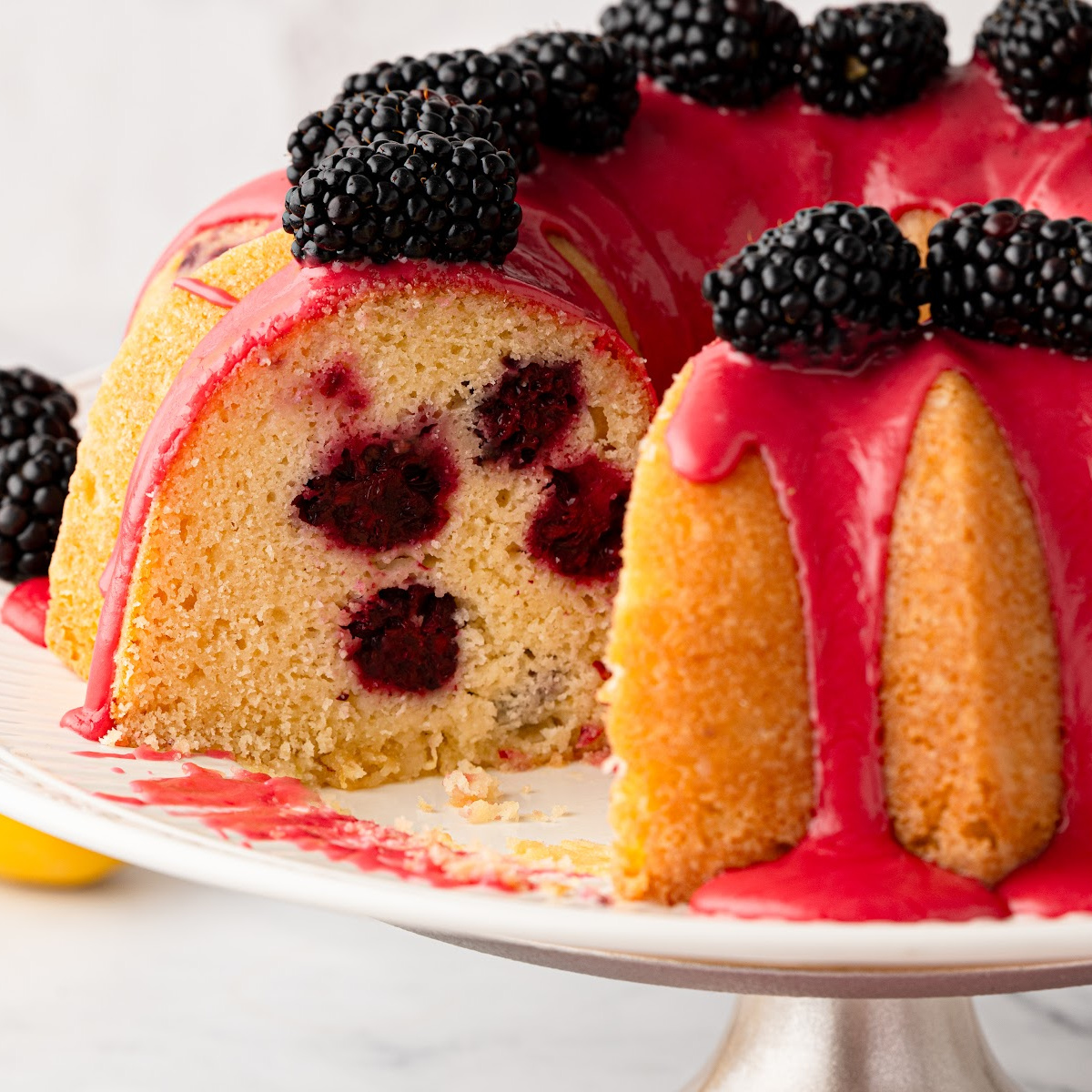
Sour Cream Lemon Blackberry Bundt Cake with Fresh Blackberry Glaze
Blackberries are folded into the batter, lemon soak is brushed over the warm cake, and a fresh blackberry glaze finishes everything off.
Servings 12 to 14 slices
Calories 430kcal
Equipment
- Bundt pan (10 - 12 cup). A 10-cup gives the cake a taller profile and better definition in the finished Bundt pan.
- Stand Mixer or hand mixer. Creams the butter, sugar and lemon zest for a lighter texture.
- mixing bowls For preparing dry ingredients and batter.
- whisk Helps evenly distribute the baking powder, baking soda and salt.
- rubber spatula Useful for folding in the blackberries without crushing them.
- Saucepan (small). Used for both the lemon soak and blackberry glaze.
- large fine mesh sieve Removes the blackberry seeds for a smoother glaze.
- pastry brush Makes it easy to apply the lemon soak evenly over the cake.
- cooling rack Allows the cake to cool properly before glazing.
Ingredients
Cake:
- 3 cups (360 g) all-purpose flour
- 2 tsps (8 g) baking powder
- ½ tsp (3 g) baking soda
- 1 tsp (6 g) fine sea salt
- 1 cup (227 g) unsalted butter softened
- 1¾ cups (350 g) granulated sugar
- 2 tbsps (12 g) lemon zest
- 4 large eggs room temperature
- 1 tbsps (15 ml) vanilla extract
- ¾ cup (180 g) full-fat sour cream
- ¼ cup (60 ml) fresh lemon juice
- 2 cups (300 g) fresh blackberries
- 2 tbsps (16 g) all-purpose flour
Lemon Soak:
- ¼ cup (60 ml) fresh lemon juice
- ¼ cup (50 g) granulated sugar
Fresh Blackberry Glaze:
- 1 cup (150 g) fresh blackberries
- 2 tbsps (30 ml) water
- 2 cups (240 g) confectioners' sugar
- 2-3 tbsps (30-45 ml) fresh lemon juice
Instructions
- Preheat the oven to 350°F (175°C). Thoroughly grease and flour a 10-cup Bundt pan, making sure every crevice is coated. Bundt cakes have a lot of detail, and taking an extra minute here makes a big difference when it comes time to remove the cake.
- Whisk together the flour, baking powder, baking soda, and salt in a medium bowl. Set aside while you prepare the batter.3 cups (360 g) all-purpose flour, 2 tsps (8 g) baking powder, ½ tsp (3 g) baking soda, 1 tsp (6 g) fine sea salt
- In a large mixing bowl, beat the butter, sugar, and lemon zest until light and fluffy, about 3 to 4 minutes. The lemon zest does most of the work when it comes to lemon flavor, so don't rush this step.1 cup (227 g) unsalted butter, 1¾ cups (350 g) granulated sugar, 2 tbsps (12 g) lemon zest
- Add the eggs one at a time, mixing well after each addition. Stir in the vanilla extract.4 large eggs, 1 tbsps (15 ml) vanilla extract
- Add half of the flour mixture and mix just until incorporated. Add the sour cream and lemon juice, then mix until combined. Add the remaining flour mixture and mix only until no dry streaks remain. Overmixing at this stage can make the cake less tender.¾ cup (180 g) full-fat sour cream, ¼ cup (60 ml) fresh lemon juice
- Toss the blackberries with the flour and gently fold them into the batter. Blackberries are larger and heavier than blueberries, so coating them helps distribute them more evenly throughout the cake.2 cups (300 g) fresh blackberries, 2 tbsps (16 g) all-purpose flour
- Transfer the batter to the prepared Bundt pan and smooth the top. Bake for 50 to 60 minutes, or until the center reaches 195°F to 200°F (90°C to 93°C) or a toothpick inserted into the thickest part of the cake comes out with a few moist crumbs attached.
- While the cake bakes, make the lemon soak. Combine the lemon juice and sugar in a small saucepan and heat over medium-low heat until the sugar dissolves completely. Set aside.¼ cup (60 ml) fresh lemon juice, ¼ cup (50 g) granulated sugar
- Allow the cake to cool in the pan for about 15 minutes. Carefully invert it onto a cooling rack. While the cake is still warm, brush the lemon soak evenly over the entire surface. The warm cake absorbs the liquid much more readily than a cooled cake, allowing the lemon flavor to move beyond the surface.
- To make the glaze, cook the blackberries and water in a small saucepan until the berries soften and release their juices. Press the mixture through a fine-mesh strainer, discarding the seeds. This extra step creates a smoother glaze while keeping the fresh blackberry flavor.1 cup (150 g) fresh blackberries, 2 tbsps (30 ml) water
- Whisk the blackberry puree, confectioners' sugar, and enough lemon juice together to create a thick but pourable glaze. If the glaze feels too thick, add a little more lemon juice. If it becomes too thin, whisk in more confectioners' sugar.2 cups (240 g) confectioners' sugar, 2-3 tbsps (30-45 ml) fresh lemon juice
- Once the cake has cooled completely, transfer it to a serving plate and drizzle the glaze over the top. Let the glaze set before slicing. The cake is excellent the day it is made, but the lemon and blackberry flavors become even more noticeable after an overnight rest.
Notes
- Most of the lemon flavor comes from the lemon zest rather than the juice. Don't skip the zest.
- Brush the lemon soak over the cake while it is still warm. The cake absorbs the liquid much more readily at this stage than after it has cooled.
- Blackberries are larger and heavier than blueberries, so coating them with flour helps distribute them more evenly throughout the cake.
- For the smoothest glaze, strain the cooked blackberries thoroughly to remove the seeds.
- Frozen blackberries may be used in the cake. Add them directly from the freezer without thawing first.
Nutrition
Serving: 125g | Calories: 430kcal | Carbohydrates: 67g | Protein: 5g | Fat: 17g | Saturated Fat: 10g | Polyunsaturated Fat: 1g | Monounsaturated Fat: 4g | Cholesterol: 85mg | Sodium: 190mg | Potassium: 115mg | Fiber: 2g | Sugar: 49g | Vitamin A: 560IU | Vitamin C: 10mg | Calcium: 55mg | Iron: 2mg