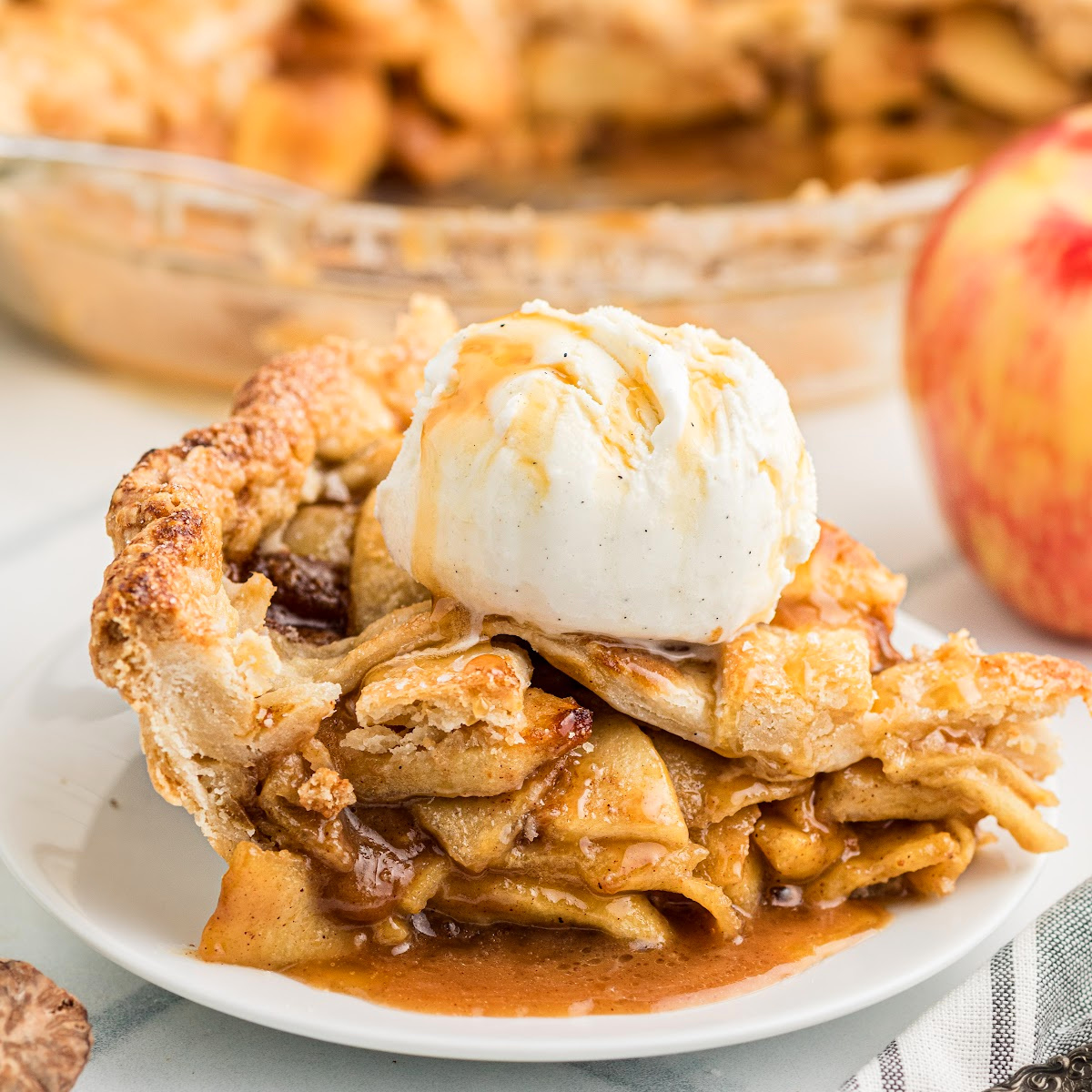
Salted Caramel Apple Pie
This Salted Caramel Apple Pie is made with a homemade all-butter lattice crust and thinly sliced Granny Smith and Honeycrisp apples coated in homemade salted caramel. The pie bakes until the pastry is golden and the apples are tender, leaving a soft caramel filling that flows slightly when sliced.
Servings 10
Calories 640kcal
Equipment
- 9-inch pie plate Preferably glass, so you can see the bottom crust as it bakes.
- mixing bowls (large) For preparing the pie dough and apple filling.
- pastry blender Cuts cold butter into the flour without warming it excessively.
- rolling pin For rolling both pastry disks and preparing the lattice strips.
- Saucepan (heavy-bottomed). Helps the sugar cook evenly when making the caramel.
- whisk (heatproof). For incorporating butter and cream into the hot caramel.
- peeler For preparing the apples before slicing.
- apple corer For preparing the apples before slicing.
- Knife or mandoline. For slicing apples approximately ⅛ inch (3 mm) thick.
- pastry brush For applying the egg wash.
- large rimmed baking sheet Catches caramel that may bubble over during baking.
- cooling rack Allows air to circulate beneath the pie as it cools.
Ingredients
Pie Crust:
- 2½ cups (313 g) all-purpose flour
- 1 tbsp (12 g) granulated sugar
- 1 tsp (6 g) table salt
- 1 cup (227 g) cold unsalted butter cubed
- 6 tbsps (90 ml) ice water
Salted Caramel:
- 1 cup (200 g) granulated sugar
- ⅓ cup (80 ml) water
- 6 tbsps (85 g) unsalted butter cubed
- ½ cup (120 ml) heavy cream
- 1 tsp (2 g) flaky sea salt
Apple Pie Filling:
- 3 large Granny Smith apples peeled, cored, and sliced ⅛ inch (3 mm) thick
- 3 large Honeycrisp or Golden Delicious apples peeled, cored, and sliced ⅛ inch (3 mm) thick
- 1 lemon juiced (approximately 2–3 tablespoons / 30–45 ml)
- ⅓ cup (71 g) packed light brown sugar
- 3 tbsps (24 g) all-purpose flour
- 1 tsp (2.5 g) ground cinnamon
- ⅓ tsp (0.5 g) ground nutmeg
Topping:
- 1 large egg beaten with 1 teaspoon (5 ml) water
- 1 tbsp (12 g) granulated sugar
- ½ tsp (2 g) flaky sea salt
Instructions
- Whisk together the flour, granulated sugar, and salt in a large mixing bowl. Add the cold, cubed butter and cut it into the flour using a pastry blender or your fingertips until the mixture contains pea-sized pieces of butter.2½ cups (313 g) all-purpose flour, 1 tbsp (12 g) granulated sugar, 1 tsp (6 g) table salt, 1 cup (227 g) cold unsalted butter
- Add the ice water, 1 tablespoon (15 ml) at a time, mixing until the dough begins to hold together when pressed. Avoid overworking the dough or adding more water than necessary. Divide into two equal portions, flatten each into a disk, wrap tightly, and refrigerate for at least 2 hours, until firm.6 tbsps (90 ml) ice water
- Combine the granulated sugar and water in a medium, heavy-bottomed saucepan over medium heat. Cook without stirring, swirling the pan occasionally, until the sugar dissolves and the syrup turns a deep amber color. Watch carefully as the color begins to change, since caramel can burn quickly.1 cup (200 g) granulated sugar, ⅓ cup (80 ml) water
- Remove the saucepan from the heat and carefully whisk in the cubed butter, followed by the heavy cream. The caramel will bubble vigorously when the dairy is added. Continue whisking until smooth, then stir in the flaky sea salt. Allow the salted caramel to cool until warm and pourable, but no longer hot.6 tbsps (85 g) unsalted butter, ½ cup (120 ml) heavy cream, 1 tsp (2 g) flaky sea salt
- Peel, core, and slice the Granny Smith and Honeycrisp or Golden Delicious apples approximately ⅛ inch (3 mm) thick. Place the slices in a large mixing bowl and toss with the fresh lemon juice. Add the brown sugar, flour, cinnamon, and nutmeg, tossing until the apples are evenly coated.3 large Granny Smith apples, 3 large Honeycrisp or Golden Delicious apples, 1 lemon, ⅓ cup (71 g) packed light brown sugar, 3 tbsps (24 g) all-purpose flour, 1 tsp (2.5 g) ground cinnamon, ⅓ tsp (0.5 g) ground nutmeg
- Pour approximately two-thirds of the salted caramel over the apple mixture and fold until the slices are coated. Reserve the remaining caramel for serving.
- Roll out one chilled dough disk on a lightly floured surface into a circle large enough to fit a 9-inch (23 cm) pie plate, allowing additional pastry for the rim. Transfer the dough to the plate, pressing it against the bottom and sides without stretching.
- Spoon the caramel-coated apple filling into the prepared crust, arranging the slices evenly and mounding them slightly in the center.
- Roll out the remaining dough disk and cut into strips for a lattice crust, weaving the strips over the apple filling. Alternatively, cover with a full sheet of pastry and cut several vents to allow steam to escape. Trim the excess dough, seal the top and bottom crusts, and crimp the rim. Refrigerate the assembled pie while the oven preheats to help keep the butter in the pastry cold.
- Preheat the oven to 450°F (232°C) using the conventional bake setting, not convection. Position a rack in the lower third of the oven.
- Brush the exposed pastry with the beaten egg mixed with 1 teaspoon (5 ml) water. Sprinkle the lattice and rim with the granulated sugar and remaining flaky sea salt.1 large egg, 1 tbsp (12 g) granulated sugar, ½ tsp (2 g) flaky sea salt
- Place the pie on a rimmed baking sheet and bake for 10 minutes at 450°F (232°C). Without removing the pie, reduce the oven temperature to 375°F (190°C) and continue baking for approximately 30 minutes, or until the crust is golden brown, the caramel filling is bubbling near the center, and the apples are tender when tested through an opening in the lattice. Baking time may vary depending on the oven. If the crust browns before the filling finishes cooking, cover the pastry loosely with aluminum foil and continue baking.
- Transfer the pie to a wire rack and allow it to cool for at least 2 hours before slicing. The caramel filling will thicken somewhat as it cools but is intended to remain soft, with some caramel flowing onto the plate when served. Drizzle individual slices with the reserved salted caramel, warming it slightly if needed.
Notes
- Slice the apples ⅛ inch (3 mm) thick so they cook without needing to be precooked.
- Use conventional bake, not convection, to prevent the lattice from browning too quickly.
- Ovens vary, so check for bubbling caramel and tender apples rather than relying only on baking time.
- The caramel filling remains soft after cooling, and some sauce will flow onto the plate when sliced.
- Pie dough and salted caramel can be made up to 3 days ahead and refrigerated separately.
- Store the cooled pie covered at room temperature for up to 2 days or refrigerate for up to 5 days.
- Nutritional information is provided as a courtesy only and should be construed as an estimate rather than a guarantee. Ingredients can vary, and Noble Pig makes no guarantees to the accuracy of this information.
Nutrition
Serving: 220g | Calories: 640kcal | Carbohydrates: 87g | Protein: 5g | Fat: 33g | Saturated Fat: 20g | Polyunsaturated Fat: 2g | Monounsaturated Fat: 9g | Cholesterol: 95mg | Sodium: 430mg | Potassium: 210mg | Fiber: 4g | Sugar: 53g | Vitamin A: 1050IU | Vitamin C: 8mg | Calcium: 45mg | Iron: 2mg