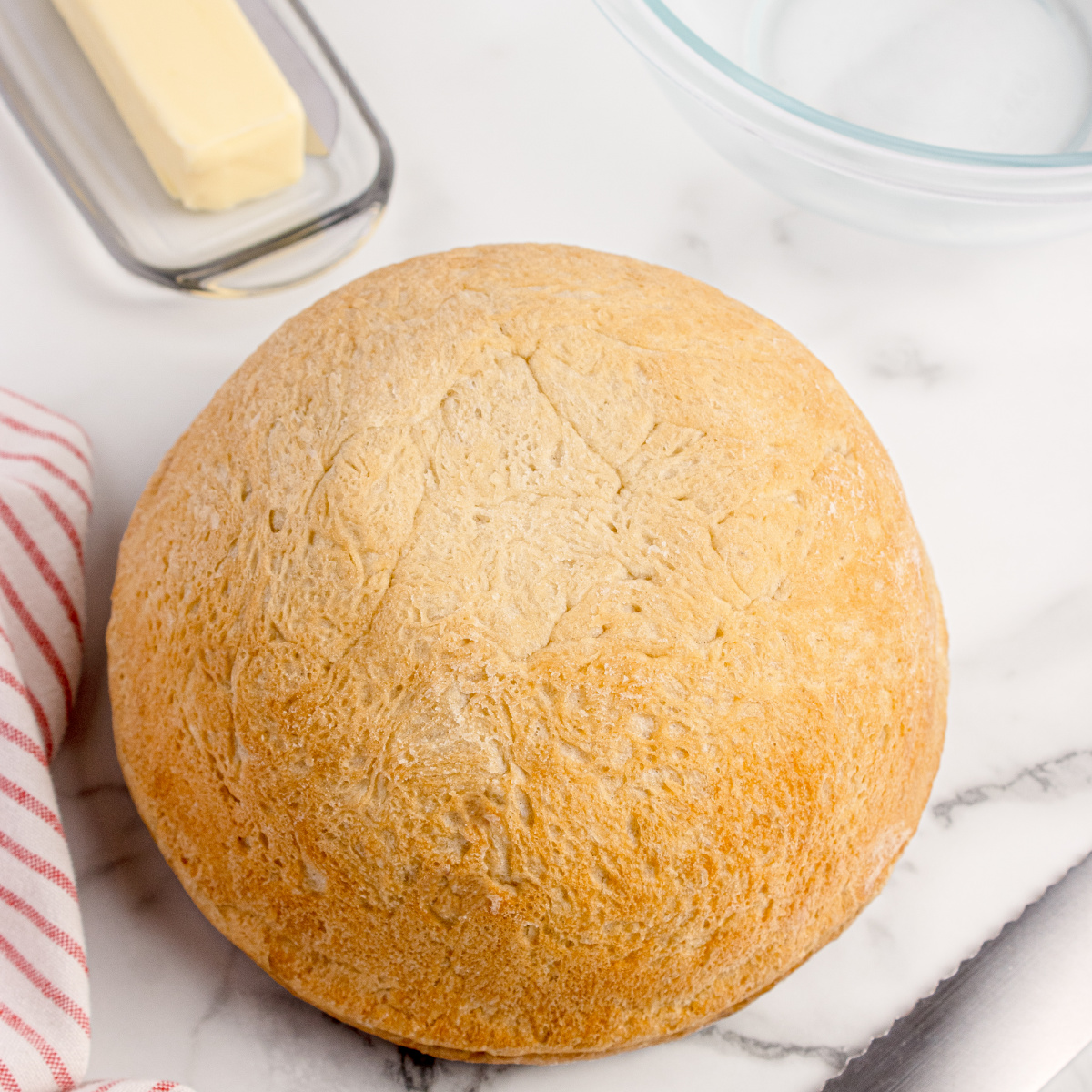
No-Knead Peasant Bread Baked in a Pyrex Bowl
This no-knead peasant bread uses a high-hydration dough that proofs and bakes in the same oven-safe Pyrex bowl. The result is a tall, golden loaf with a crisp crust, soft crumb, and no need for a Dutch oven or specialty bread-baking equipment.
Servings 8 to 10 slices
Calories 245kcal
Equipment
- mixing bowls (large) For mixing and fermenting the high-hydration dough.
- Pyrex 325 2.5 quart Glass Mixing Bowl Supports the dough during the second rise and creates the loaf's tall rounded shape.
- digital thermometer The most reliable way to determine when the center of the loaf is fully baked.
- wire rack Allows air to circulate around the loaf while it cools.
- kitchen scale For the most accurate measurement of ingredients.
- oven thermometer If you're unsure of how hot/cold your oven runs, this is the best way to figure it out.
Ingredients
- about 4 cups (17.6 oz / 500 g) all-purpose flour
- 1 tsp (0.2 oz / 6 g) fine sea salt
- 2 tbsps (0.9 oz / 25 g) granulated sugar
- 1 packet (7 g / 2¼ tsps) RapidRise yeast
- 2 cups (480 ml) warm water (100-110°F / 38-43°C)
- cooking spray
Instructions
- Add the flour, salt, sugar, and instant yeast to a large bowl and stir to combine. Pour in the warm water (38-43°C) and mix until no dry flour remains. The dough will be very loose and sticky, which is exactly what you want for this high-hydration bread.about 4 cups (17.6 oz / 500 g) all-purpose flour, 1 tsp (0.2 oz / 6 g) fine sea salt, 2 tbsps (0.9 oz / 25 g) granulated sugar, 1 packet (7 g / 2¼ tsps) RapidRise yeast, 2 cups (480 ml) warm water
- Cover the bowl and place it in a warm spot until the dough has doubled in size, about 1½ to 2 hours. A slightly warm oven with the light on works well. The dough should look puffy and airy before moving to the next step.
- Lightly flour your work surface and dust the top of the dough with a little flour. Gently fold the outer edges underneath to form a rough ball, then transfer the dough to the counter and tuck the edges underneath again until a smooth round shape forms. Avoid overworking the dough so it retains the air developed during the rise.
- Generously coat a 2.5-quart (2.4 L) oven-safe Pyrex bowl with nonstick spray or you can brush with olive oil. Place the dough seam-side down in the bowl, cover loosely, and let it rise until puffy and slightly above the rim, about 45 to 60 minutes. The bowl supports the dough as it rises and helps create the loaf's tall, rounded shape.cooking spray
- While the dough completes its second rise, preheat the oven to 350°F (175°C). Place the bowl in the oven and bake for 40 to 50 minutes, or until the loaf is deep golden brown and the center reaches 190-195°F (88-91°C) on an instant-read thermometer. If your oven tends to run hot, reduce the temperature by 25°F (15°C).
- Carefully remove the loaf from the bowl and transfer it to a wire rack. Let it cool for at least 30 minutes before slicing. This resting time allows the crumb to finish setting and prevents a gummy interior.
Notes
- Do not use decorative glass bowls, serving bowls, vintage glassware of unknown origin, or any bowl with chips, cracks, or other damage.
- The Pyrex bowl should be at room temperature before use. Avoid sudden temperature changes, also known as thermal shock, which can cause glass to crack or shatter.
- Do not place a cold glass bowl into a hot oven.
- Do not place a hot glass bowl onto a cold, wet, stone, metal, or granite surface. Set it on a dry towel, wooden cutting board, or cooling rack instead.
- This dough is intentionally high-hydration and will look much wetter than traditional bread dough. Resist the urge to add additional flour. The extra moisture helps create a lighter crumb without kneading.
- For the most accurate results, weigh the flour and water with a kitchen scale.
- The loaf is fully baked when the center reaches 190-195°F (88-91°C). Because the loaf is tall and baked in glass, color alone is not always the best indicator of doneness.
- If your oven tends to bake hot, reduce the oven temperature by 25°F (15°C). Glass bakeware heats differently than metal and may brown the crust more quickly.
Nutrition
Serving: 127g | Calories: 245kcal | Carbohydrates: 51g | Protein: 7g | Fat: 1g | Sodium: 293mg | Potassium: 72mg | Fiber: 2g | Sugar: 3g | Calcium: 8mg | Iron: 3mg