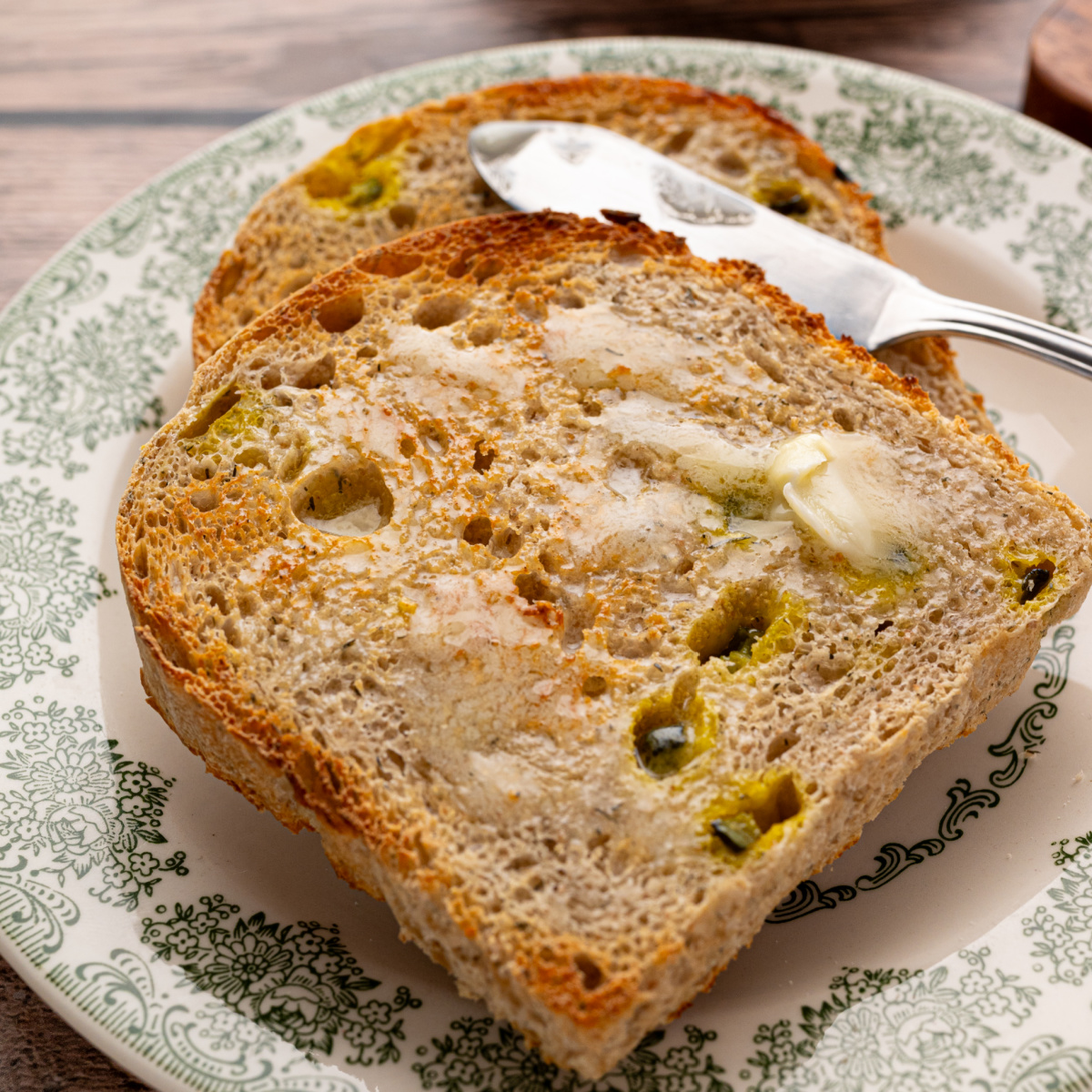
Dill Pickle Sourdough Sandwich Bread
Dill pickle sourdough sandwich bread combines chopped dill pickles, pickle brine, dried dill, and garlic in a tangy homemade loaf. Baked uncovered in a Pullman pan, it makes excellent grilled cheese, deli sandwiches, and buttered toast.
Servings 12 slices
Calories 158kcal
Equipment
- kitchen scale Measures ingredients accurately for consistent dough hydration.
- mixing bowls (large). Provides room for mixing, folding, and fermenting the dough.
- dough whisk or sturdy spoon. Combines the ingredients without overworking the dough.
- bench scraper Helps transfer and shape the dough.
- 9x4x4-inch Pullman loaf pan (23x10x10 cm). Creates tall, even sandwich slices. Bake without the lid.
- parchment paper or baking spray. Prevents the bread from sticking to the pan.
- instant-read thermometer Checks the internal temperature for doneness.
- cooling rack Allows air to circulate around the loaf as it cools.
Ingredients
- 250 g (8.8 oz) water
- 40 g (1.4 oz) dill pickle brine
- 75 g (2.6 oz) active sourdough starter or levain at 100% hydration
- 15 g (0.5 oz) olive oil
- 400 g (14.1 oz) bread flour
- 35 g (1.2 oz) whole wheat flour
- 8 g (0.28 oz) fine sea salt
- 2 tsps (~2 g) dried dill weed
- 1 tsp (~3 g) garlic powder
- 75 g (2.6 oz) dill pickles chopped, thoroughly drained and patted dry
Instructions
- In a large mixing bowl, combine the water, pickle brine, active sourdough starter or levain, and olive oil. Stir until the starter is evenly dispersed. Add the bread flour, whole wheat flour, salt, dried dill weed, garlic powder, and thoroughly drained and dried chopped dill pickles. Mix by hand, with a dough whisk, or in a stand mixer until no dry flour remains and a shaggy dough forms. Cover the bowl and let the dough rest for 30 minutes to allow the flour to hydrate.250 g (8.8 oz) water, 40 g (1.4 oz) dill pickle brine, 75 g (2.6 oz) active sourdough starter or levain, 15 g (0.5 oz) olive oil, 400 g (14.1 oz) bread flour, 35 g (1.2 oz) whole wheat flour, 8 g (0.28 oz) fine sea salt, 2 tsps (~2 g) dried dill weed, 1 tsp (~3 g) garlic powder, 75 g (2.6 oz) dill pickles
- Perform three sets of stretch-and-folds or coil folds, spacing each set 30 minutes apart. Use lightly oiled hands to prevent sticking, and handle the dough gently to avoid tearing the developing gluten. After the final set, cover the bowl and continue bulk fermentation at room temperature (70–75°F / 21–24°C) until the dough has increased in volume by approximately 50%, feels airy, and shows visible signs of fermentation. Allow approximately 6–8 hours for bulk fermentation, adjusting as needed based on starter activity and room temperature rather than relying solely on the clock.
- Transfer the dough to a lightly floured work surface. Gently preshape it into a loose rectangle, taking care not to press out all the accumulated gas. Let the dough rest uncovered for 20 minutes to relax the gluten before final shaping.
- Shape the dough into a snug sandwich loaf by gently flattening it into a rectangle, folding the sides inward, and rolling it into a log approximately the length of the Pullman pan. Place seam-side down in a lightly greased or parchment-lined 9 x 4 x 4-inch (23 x 10 x 10 cm) Pullman loaf pan. Cover loosely and proof at room temperature for approximately 1½–2½ hours, until the dough is visibly puffy and has risen noticeably in the pan. Alternatively, refrigerate the covered dough for 8–12 hours for an overnight proof. If refrigerated, allow additional room-temperature proofing before baking if the dough has not risen sufficiently.
- Preheat the oven to 375°F (190°C). Bake the loaf uncovered, without the Pullman pan lid, on the center oven rack for 40–45 minutes, until the crust is golden brown and the center registers approximately 200°F (93°C) on an instant-read thermometer. If the top begins browning too quickly, loosely tent with aluminum foil after approximately 20 minutes. Baking time may vary depending on the oven and loaf pan.
- Remove the bread from the oven and carefully turn it out of the Pullman pan onto a wire rack. Allow the loaf to cool completely for at least 2 hours before slicing. Cooling allows the interior to finish setting and prevents a gummy texture when cutting the sourdough sandwich bread.
Notes
- Use an active, bubbly sourdough starter or levain. Inactive sourdough discard will not reliably raise this bread without additional leavening.
- Drain the chopped pickles thoroughly and pat dry with paper towels before adding them to the dough. Excess surface moisture can make the dough stickier and more difficult to handle.
- Fermentation times are estimates. Starter activity, room temperature, and the salt and acidity of the pickle brine can affect how quickly the dough rises.
- For additional pickle acidity, replace 10–15 grams of water with an equal weight of pickle brine. Increasing the brine also increases the salt content.
- The Pullman loaf pan is used without its lid. This allows the dough to rise above the pan and develop a rounded top rather than the square profile of a covered Pullman loaf.
- Store completely cooled bread in an airtight container or bread bag at room temperature for 2–3 days. For longer storage, freeze individual slices for up to 3 months.
- Nutritional information is provided as a courtesy only and should be construed as an estimate rather than a guarantee. Ingredients can vary, and Noble Pig makes no guarantees to the accuracy of this information.
Nutrition
Serving: 75g | Calories: 158kcal | Carbohydrates: 30g | Protein: 5g | Fat: 2g | Saturated Fat: 0.3g | Polyunsaturated Fat: 0.3g | Monounsaturated Fat: 1g | Sodium: 380mg | Potassium: 75mg | Fiber: 2g | Sugar: 0.5g | Vitamin A: 5IU | Vitamin C: 0.1mg | Calcium: 12mg | Iron: 1mg