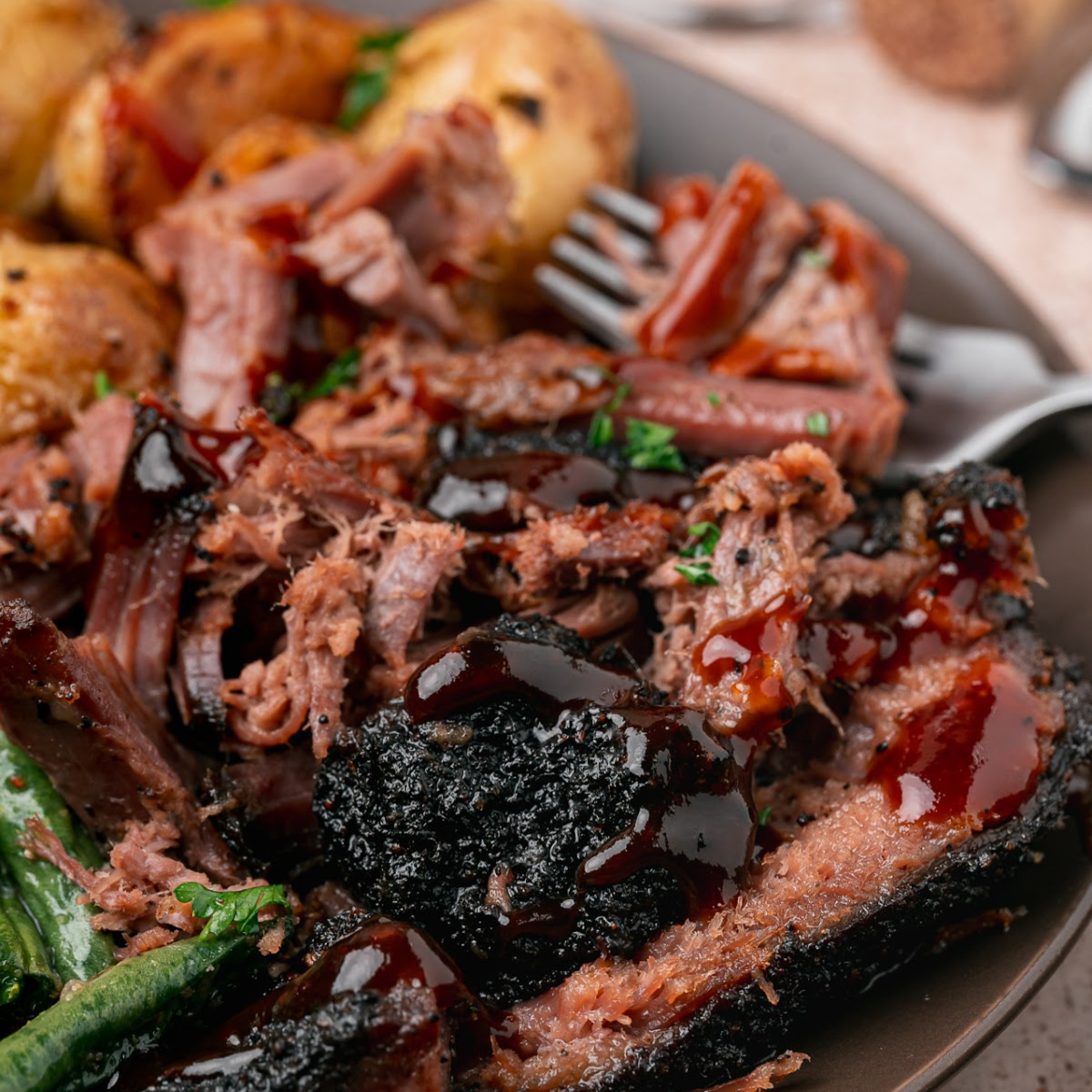
Coffee Rubbed Oven Brisket
Coffee Rubbed Oven Brisket is made with a whole packer brisket seasoned with dark roast coffee, brown sugar, chipotle, and smoked paprika. An overnight dry brine and slow oven roast create a nearly black crust that looks like it came out of a smoker. The flat is sliced, the point is pulled, and both are served with barbecue sauce.
Servings 10
Calories 650kcal
Equipment
- wire rack with rimmed baking sheet Elevates brisket for even roasting. Catches rendered fat and cooking juices.
- 18" Heavy Duty Aluminum Foil Wraps brisket to retain moisture.
- instant-read thermometer Monitors internal temperature without opening the oven.
- Cutting board Provides room for slicing and separating the brisket.
- meat shredders Shreds the tender point.
- sharp carving knife Slices brisket against the grain.
- mixing bowls For mustard mixture and coffee rub.
Ingredients
- 1 (8-9 lbs / 3.6 - 4.1 kg) whole packer beef brisket including flat and point, trimmed to a ¼-inch (6-mm) fat cap
- 2 tbsps (30 g) yellow mustard
- 1 tsp (5 ml) liquid smoke
- 2 tbsps kosher salt (approximately 18 g Diamond Crystal or 30 g Morton)
- 2 tbsps (25g) light brown sugar or dark brown sugar
- ¼ cup (~20 g) finely ground dark roast coffee unbrewed
- 1 tbsp (7 g) ground black pepper
- 1 tbsp (7 g) smoked paprika
- 1 tbsp (7 g) chipotle chile powder
- 1 tbsp (9 g) garlic powder
- 1 tbsp (7 g) onion powder
Instructions
- Trim away the silver skin and any thick, hard exterior fat from the whole packer brisket, leaving approximately ¼ inch (6 mm) of the softer fat cap intact. Pat the meat dry with paper towels. Identify the direction of the grain on the flat before seasoning, since the dark coffee crust can make it difficult to see after roasting.1 (8-9 lbs / 3.6 - 4.1 kg) whole packer beef brisket
- Stir the yellow mustard and liquid smoke together in a small bowl. Spread a thin, even coating over the top, bottom, and sides of the brisket, making sure the liquid smoke is distributed across the beef.2 tbsps (30 g) yellow mustard, 1 tsp (5 ml) liquid smoke
- Mix the kosher salt, brown sugar, finely ground dark roast coffee, black pepper, smoked paprika, chipotle powder, garlic powder, and onion powder in a bowl. Coat the brisket on all sides, pressing the seasoning firmly onto the surface.2 tbsps kosher salt, 2 tbsps (25g) light brown sugar, ¼ cup (~20 g) finely ground dark roast coffee, 1 tbsp (7 g) ground black pepper, 1 tbsp (7 g) smoked paprika, 1 tbsp (7 g) chipotle chile powder, 1 tbsp (9 g) garlic powder, 1 tbsp (7 g) onion powder
- Place the brisket fat side up on a wire rack set inside a large roasting pan or rimmed baking sheet. Refrigerate uncovered for at least 8 hours or up to 24 hours. The salt will season the beef while the exposed surface gradually dries, helping the coffee rub develop a firmer crust during roasting.
- Remove the brisket from the refrigerator approximately 30 minutes before cooking. Preheat the oven to 275°F (135°C). Insert an oven-safe probe thermometer into the thickest portion of the brisket, avoiding large deposits of fat.
- Roast uncovered until the internal temperature reaches approximately 165°F (74°C), about 3–4 hours. The coffee rub should have formed a very dark, firmly attached crust, with rendered fat visible on the surface. The exterior may look almost black, which is expected with the coffee and chipotle seasoning.
- Remove the brisket from the oven and place it on overlapping sheets of heavy-duty aluminum foil. Spoon some of the accumulated pan juices over the meat, then wrap tightly to enclose the brisket completely.
- Return the wrapped brisket to the 275°F (135°C) oven and continue cooking until the internal temperature reaches approximately 200–205°F (93–96°C), usually another 2–3 hours, although larger briskets may require additional time. Begin checking tenderness at 200°F (93°C), testing both the flat and point with a thermometer probe or thin skewer. Continue cooking until the probe passes through the meat with very little resistance, even if the internal temperature exceeds 205°F (96°C).
- Remove the brisket from the oven and leave it wrapped for at least 1 hour before cutting. Carefully open the foil, watching for hot steam, and collect the accumulated cooking juices for serving.
- Locate the natural seam of fat separating the flat from the point. Follow the seam with a sharp knife to separate the two muscles, trimming away any large deposits of excess fat.
- Place the flat on a cutting board and identify the direction of the muscle fibers. Slice against the grain into approximately ¼-inch (6-mm) slices.
- Use two forks or meat claws to shred the point, discarding any large deposits of fat. Toss the pulled beef with some of the reserved cooking juices. Spoon additional juices over the sliced flat and serve with BBQ sauce on the side, if desired.
Notes
- Use plain, finely ground dark roast coffee. The recipe calls for ground coffee, not brewed coffee, instant coffee, or flavored coffee.
- The uncovered refrigerator rest is necessary for the dry brine. Allow at least 8 hours, although the brisket can be seasoned up to 24 hours before cooking.
- The cooking times are estimates. Brisket thickness, fat content, starting temperature, and individual oven performance can affect how long it takes. Plan for additional cooking time when serving at a specific hour.
- The coffee rub will become extremely dark during roasting. The nearly black crust is expected and doesn't automatically mean the seasoning has burned.
- Begin checking tenderness at approximately 200°F (93°C). Both the flat and point should offer very little resistance when tested with a thermometer probe or thin skewer. Some briskets may need to cook beyond 205°F (96°C).
- Rest the brisket wrapped for at least 1 hour before separating the flat and point.
- Refrigerate leftover brisket in an airtight container for up to 4 days. Reheat covered at 300°F (150°C) with some of the reserved cooking juices until heated through.
- Freeze brisket for up to 3 months. Larger portions retain moisture better than thin slices, so freeze in thicker sections when possible.
- Nutritional information is provided as a courtesy only and should be construed as an estimate rather than a guarantee. Ingredients can vary, and Noble Pig makes no guarantees to the accuracy of this information.
Nutrition
Serving: 210g | Calories: 650kcal | Carbohydrates: 5g | Protein: 58g | Fat: 44g | Saturated Fat: 17g | Polyunsaturated Fat: 2g | Monounsaturated Fat: 20g | Cholesterol: 195mg | Sodium: 1150mg | Potassium: 950mg | Fiber: 1g | Sugar: 3g | Vitamin A: 600IU | Vitamin C: 1mg | Calcium: 55mg | Iron: 5mg