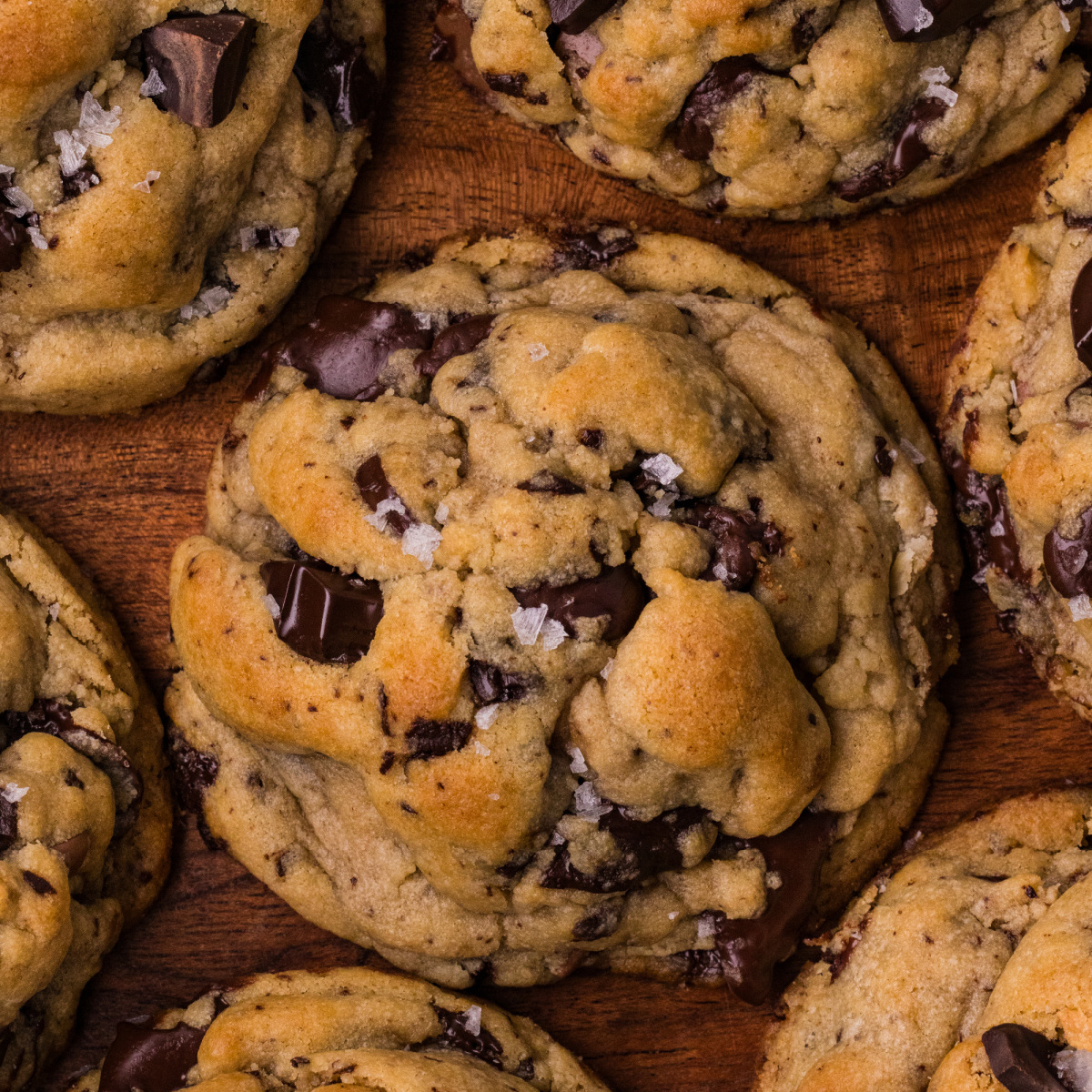
Brown Butter Chocolate Chip Cookies
These brown butter chocolate chip cookies have golden tops, soft, chewy centers, and melted dark and milk chocolate. Browned butter adds a rich, nutty flavor, while the large portions of dough bake into thick cookies that stay soft as they cool.
Servings 10
Calories 580kcal
Equipment
- Saucepan (medium). For browning the butter and dry milk powder while allowing enough room to stir and scrape the bottom.
- mixing bowls (heatproof). For cooling the browned butter and mixing the cookie dough.
- kitchen scale (digital). For weighing the browned butter after cooking and dividing the dough into equal portions.
- whisk For distributing the dry ingredients before adding the chocolate.
- rubber spatula For mixing the cookie dough without overworking the flour.
- 2 baking sheet For chilling the portioned dough and baking the cookies.
- parchment paper For lining the baking sheets and preventing sticking.
- 3-inch round cookie cutter Optional, for shaping the cookies immediately after baking.
Ingredients
- 1 cup (226 g) unsalted butter
- 2 tbsps (16 g) dry milk powder
- ⅔ cup (80 g) all-purpose flour
- 1¾ cups (210 g) bread flour
- 2 tsps (5 g) cornstarch
- 1 tsp (5 g) baking soda
- 3 oz (85 g) dark chocolate chips
- 4 oz (113 g) milk chocolate chips
- 3 oz (85 g) dark chocolate bar chopped
- ¾ cup (160 g) dark brown sugar
- ½ cup (99 g) granulated sugar
- 1 tsp (3 g) kosher salt
- 1 large egg
- 1 large egg yolk
- 2 tsps (10 g) vanilla extract
- 1 tsp (7 g) molasses
- additional dark chocolate chunks optional for topping
- Maldon flaky sea salt optional for topping
Instructions
- Melt the unsalted butter in a medium saucepan over medium heat, then add the dry milk powder and stir continuously, scraping the bottom and sides of the pan to prevent the milk solids from sticking or burning. Continue cooking until the butter is fragrant and the milk solids reach a deep almond-to-pecan color, removing the saucepan from the heat before they darken to a walnut color, which can result in a bitter flavor.1 cup (226 g) unsalted butter, 2 tbsps (16 g) dry milk powder
- Immediately transfer the browned butter, including all the toasted milk solids, to a heatproof glass mixing bowl to stop the browning process. The easiest way to check the weight is to weigh the empty bowl beforehand and record its weight, then subtract that amount from the weight of the bowl containing the browned butter. If the browned butter weighs less than 220 g, add enough water to reach 220 g, then allow it to cool to room temperature before continuing with the cookie dough.
- While the browned butter cools, whisk together the all-purpose flour, bread flour, cornstarch, and baking soda in a separate mixing bowl. Add the dark chocolate chips, milk chocolate chips, and chopped dark chocolate, stirring until the chocolate is evenly distributed through the flour mixture.⅔ cup (80 g) all-purpose flour, 1¾ cups (210 g) bread flour, 2 tsps (5 g) cornstarch, 1 tsp (5 g) baking soda, 3 oz (85 g) dark chocolate chips, 4 oz (113 g) milk chocolate chips, 3 oz (85 g) dark chocolate bar
- Add the brown sugar, granulated sugar, and kosher salt to the cooled browned butter, stirring until thoroughly incorporated. Add the whole egg, egg yolk, vanilla extract, and molasses, then stir vigorously until the mixture becomes slightly thicker and more uniform in consistency.¾ cup (160 g) dark brown sugar, ½ cup (99 g) granulated sugar, 1 tsp (3 g) kosher salt, 1 large egg, 1 large egg yolk, 2 tsps (10 g) vanilla extract, 1 tsp (7 g) molasses
- Fold the flour and chocolate mixture into the butter mixture using a spatula, mixing until no dry flour remains and the chocolate is distributed through the dough. Stop mixing once the ingredients are incorporated to avoid developing excess gluten, which can make the cookies tougher.
- Divide the cookie dough into 10 equal portions, weighing approximately 4 ounces (113 g) each (weigh your total dough first and divide by 10 for the most accurate measurement). Using your fingers, loosely press each portion into a tall, irregular mound rather than rolling it into a smooth ball or flattening it, allowing the dough to retain its uneven surface as it bakes.
- Arrange the portioned cookie dough on a baking sheet or in a covered container and refrigerate for at least 2 hours, or up to 48 hours for additional flavor development. Chilling the dough also allows the flour to absorb moisture and helps control spreading during baking.
- Preheat the oven to 400°F (204°C) and line a baking sheet with parchment paper. Arrange the chilled dough mounds several inches apart to allow for spreading, then bake for approximately 8 minutes, until the tops have lost their shine, the bottoms are beginning to brown, and the raised areas of dough are lightly golden. The centers should still appear soft when the cookies are removed from the oven, so avoid extending the baking time until they look completely firm.
- Immediately after removing the baking sheet from the oven, use a round cookie cutter slightly larger than each cookie, a spatula, a ramekin to carefully shape any uneven sides into a more circular form. Press additional dark chocolate chunks into the warm tops if desired, then finish with a sprinkling of Maldon flaky sea salt.additional dark chocolate chunks, Maldon flaky sea salt
- Leave the cookies on the baking sheet until completely cooled, allowing the residual heat to continue setting the centers without drying them out in the oven. The cookies will firm as they cool while retaining the soft, chewy texture developed during baking.
Notes
- Regular nonfat dry milk powder works well for browning with the butter. Liquid milk can't be substituted because it changes the moisture content.
- After browning, the butter and toasted milk solids should weigh 220 g. If the mixture weighs less, add enough water to restore the weight before cooling.
- The cookie dough should be portioned before refrigeration. Chill for at least 2 hours or up to 48 hours.
- For smaller cookies, divide the dough into approximately 2-ounce (57 g) portions and bake at 400°F (204°C) for 6–7 minutes, using the same visual cues for doneness.
- The cookies will appear soft when removed from the oven and need to cool completely on the baking sheet before being moved.
- Store cooled cookies in an airtight container at room temperature for up to 4 days or freeze for up to 3 months. Refrigerated, portioned dough can be frozen for up to 3 months and thawed overnight in the refrigerator before baking.
- Nutritional information is provided as a courtesy only and should be construed as an estimate rather than a guarantee. Ingredients can vary, and Noble Pig makes no guarantees to the accuracy of this information.
Nutrition
Serving: 113g | Calories: 580kcal | Carbohydrates: 71g | Protein: 8g | Fat: 30g | Saturated Fat: 18g | Polyunsaturated Fat: 2g | Monounsaturated Fat: 8g | Cholesterol: 83mg | Sodium: 340mg | Potassium: 260mg | Fiber: 3g | Sugar: 41g | Vitamin A: 650IU | Calcium: 80mg | Iron: 3mg